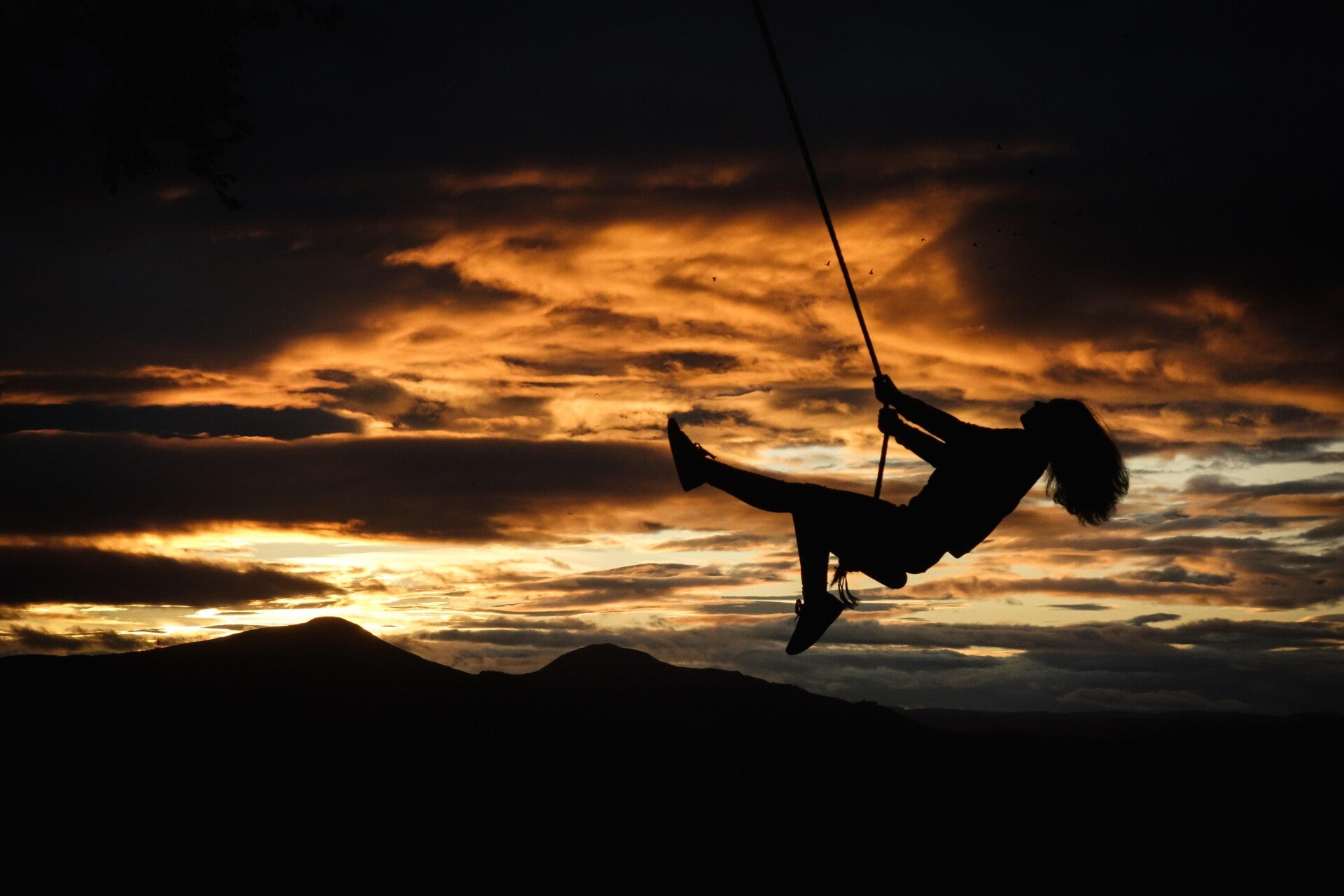
There are moments when we feel an almost physical need to escape the gravity of the everyday: to step away, if only briefly, from roads and timetables, traffic and screens, routines and responsibilities. In the largest cities, this invisible web of obligations can begin to resemble a modern labyrinth, one whose walls are not made of stone, but of habits, notifications and the constant pressure to keep moving.
Ancient myth understood this longing long before we had a name for it. When Daedalus realizes that he cannot escape Crete by land or sea, Ovid gives him one of the most beautiful declarations of freedom in classical literature:
“At caelum certe patet.”—The sky, at least, remains open.
Then comes the equally powerful thought: “non possidet aera Minos”—Minos may possess everything else, but he does not possess the air.
It is difficult to imagine words better suited to that ancient and persistent human dream we call flight. Flying is not simply a matter of rising higher. It is a way of finding a direction the labyrinth never anticipated.
Perhaps this is why a zipline, beyond its playful and adrenaline-fuelled appeal, can awaken something unexpectedly profound. The moment we leave the platform, walking is no longer necessary. The path disappears and the contours of the land cease to dictate our movement. For a few seconds, the body abandons its familiar rhythm, gives itself over to the air and crosses the landscape in a way that does not naturally belong to it.
The freedom may be simulated, but the wind against the face is real. So is the emptiness beneath our feet, and so is the mountain that we no longer gaze up at from below but suddenly cross from above.
The experience contains a beautiful paradox: we feel free precisely because we are hanging by a thread.

In Greek mythology, Ariadne’s thread leads Theseus out of the Labyrinth. It is a bond, but not a chain. It does not imprison him; it shows him the way out. The steel cable of a zipline can be imagined in much the same way, as Ariadne’s thread lifted from the earth and suspended in the sky. We are secured so that we can let go, attached so that we can fly.
This apparent contradiction reminds us that not every constraint is a prison. Some ties limit our freedom, while others, consciously chosen, allow us to reach places and states that would otherwise remain beyond us.
In Plato’s Phaedrus, Socrates describes the fully winged soul as soaring upwards, while the soul that has lost its wings descends towards the solid, earthly world. Yet when we contemplate beauty, he suggests, we may feel our wings beginning to grow once more, awakening within us the desire to rise.
Perhaps this is also what we seek when we travel through Norway. We are not searching only for new places, but for something capable of interrupting the continuity of habit and restoring our capacity for wonder. In Norway, a zipline rarely separates the thrill from the landscape. The cable carries us above forests, rivers, mountains and fjords, past waterfalls and towards valleys shaped by ancient ice. The adrenaline may last only a few seconds, but the vastness of what we have seen remains with us for much longer.
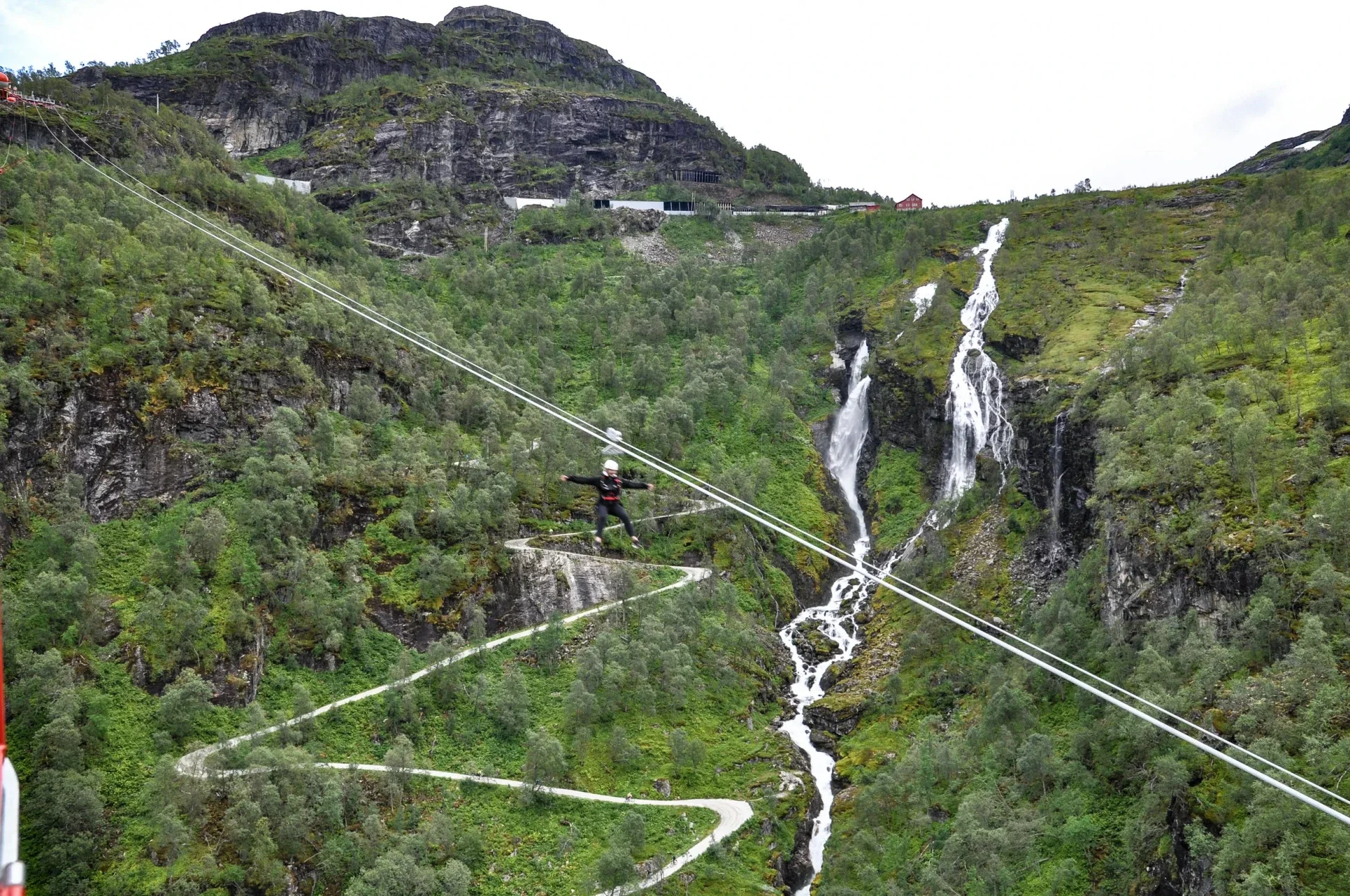
Photo: www.fjordsafari.com
Flåm: Into a Valley Carved by Ice
The journey might begin in Flåm, where the railway climbs away from the fjord through one of Norway’s most dramatic valleys. Near Vatnahalsen, high above the village, the train leaves travellers within reach of a very different descent.
The Flåm Zipline stretches for 1,381 meters, drops 305 vertical metres and can reach speeds of up to 100 kilometers per hour. Its operator describes it as the longest zipline in Scandinavia. Yet the figures reveal only part of the experience.
From the launch platform, the cable disappears into Flåmsdalen. Far below, the river follows the valley floor while steep green slopes rise on either side. Ahead lies Kårdal, a historic mountain farm, and beyond it the landscape descends gradually towards the fjord. In a matter of moments, the zipline crosses a space that glaciers and rivers spent geological ages creating.
There is a quiet historical continuity here. Modern ziplines are descendants of the cable systems once used on remote mountain farms to move materials and supplies across difficult terrain. A technology born from the practical hardships of mountain life has become a way of seeing the mountain anew.
After landing, the journey does not have to end. The Rallarvegen continues down the valley towards Flåm, inviting travellers to complete the descent on foot or by bicycle. The day acquires its own natural rhythm: first the railway, then the brief surrender to the air, and finally the return to the earth.
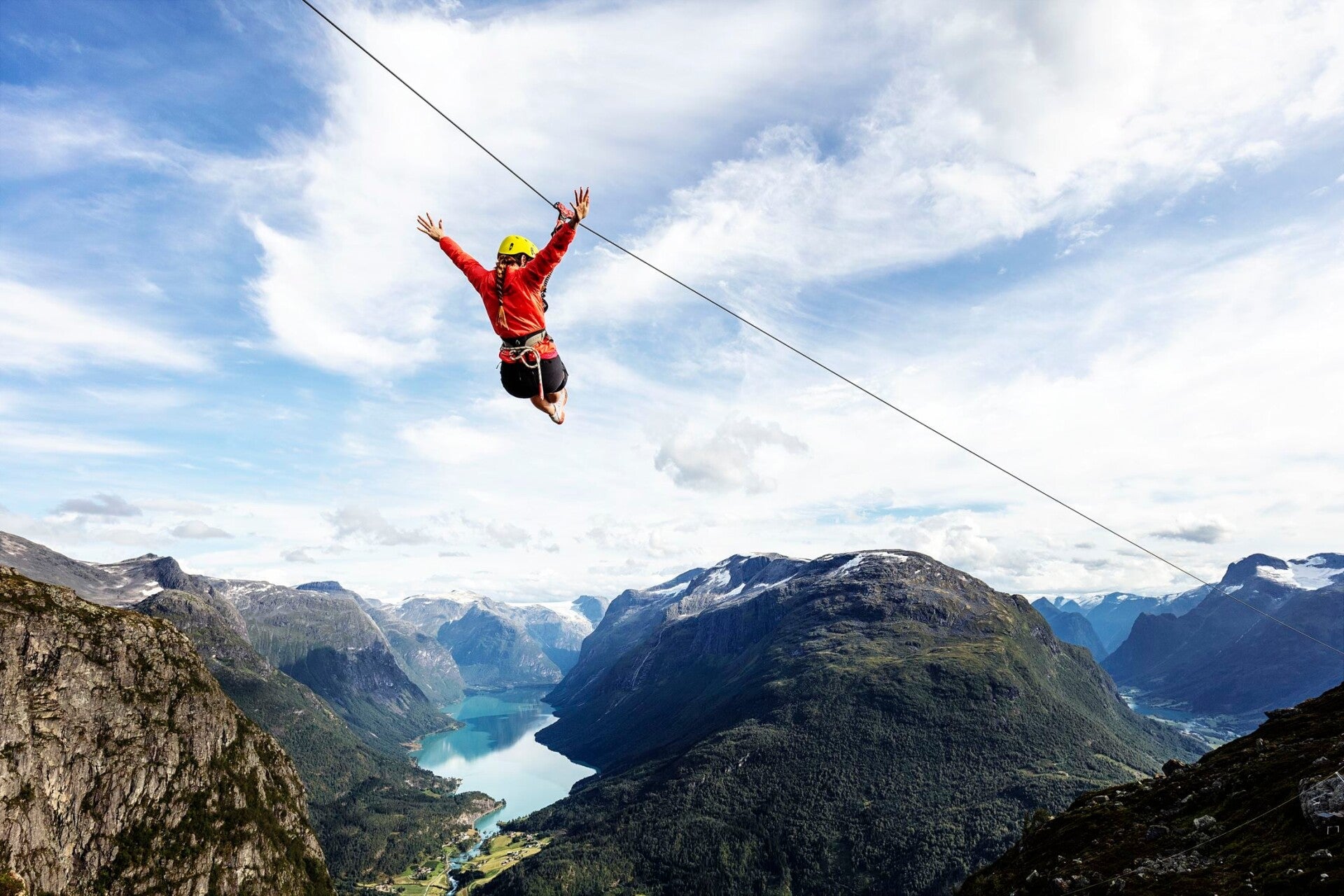
Photo: www.nordfjord.no
Loen: Entering the View
Farther north, at Loen, the relationship between height and landscape becomes even more dramatic. The Loen Skylift rises from the fjord to Mount Hoven, 1,011 metres above the water. Near the upper station, two zipline sections, 125 and 95 meters long, cross the high mountain terrain.
These are not Norway’s longest ziplines, but length is almost irrelevant here. What matters is where they are suspended. Nordfjord opens far below, encircled by mountains and valleys carved by ice. From this height, roads and buildings shrink until the human presence seems almost incidental.
At a viewpoint, we stand still and admire the landscape from its edge. On a zipline, the landscape begins to move around us. The foreground falls away, the perspective shifts with every second, and we are no longer merely looking at the view: we have entered it.
This is not about conquering the mountain, an idea that feels out of place in a landscape of such scale. If anything, the experience asks for the opposite. For a moment, we stop resisting gravity and allow ourselves to be carried through space.
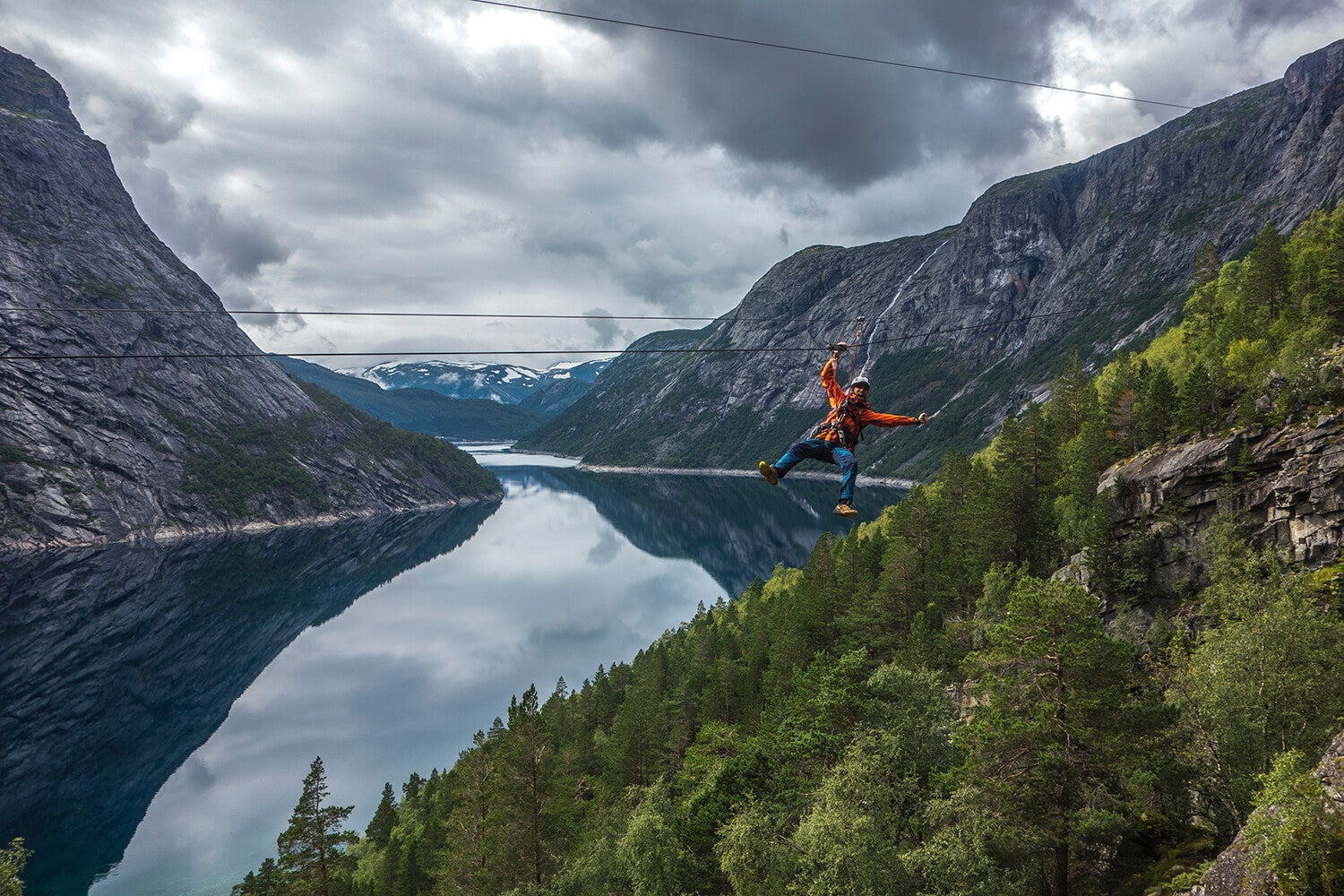
Photo: www.trolltunga-active.com
Trolltunga: A Flight That Must Be Earned
The landscape changes again near Trolltunga, above the deep blue waters of Ringedalsvatnet. Here, Trolltunga Active combines hiking and flight in a longer mountain experience. After approaching on foot beside the lake, participants reach three ziplines covering approximately 600 meters and descending around 200 metres back towards the water. The excursion lasts several hours and is classified by the operator as advanced.
Here, the flight does not come effortlessly. It must be reached. Before leaving the ground, travellers walk, gain elevation and feel the distance in their legs. The zipline does not replace that physical encounter with the mountain; it becomes the final chapter of it.
There is something deeply satisfying in the contrast. The trail teaches us how slowly a human body moves through steep terrain. Then the cable carries that same body across the distance in seconds. The mountain gives the flight a sense of scale, while the effort of reaching the launch point makes the moment of release feel all the more vivid.
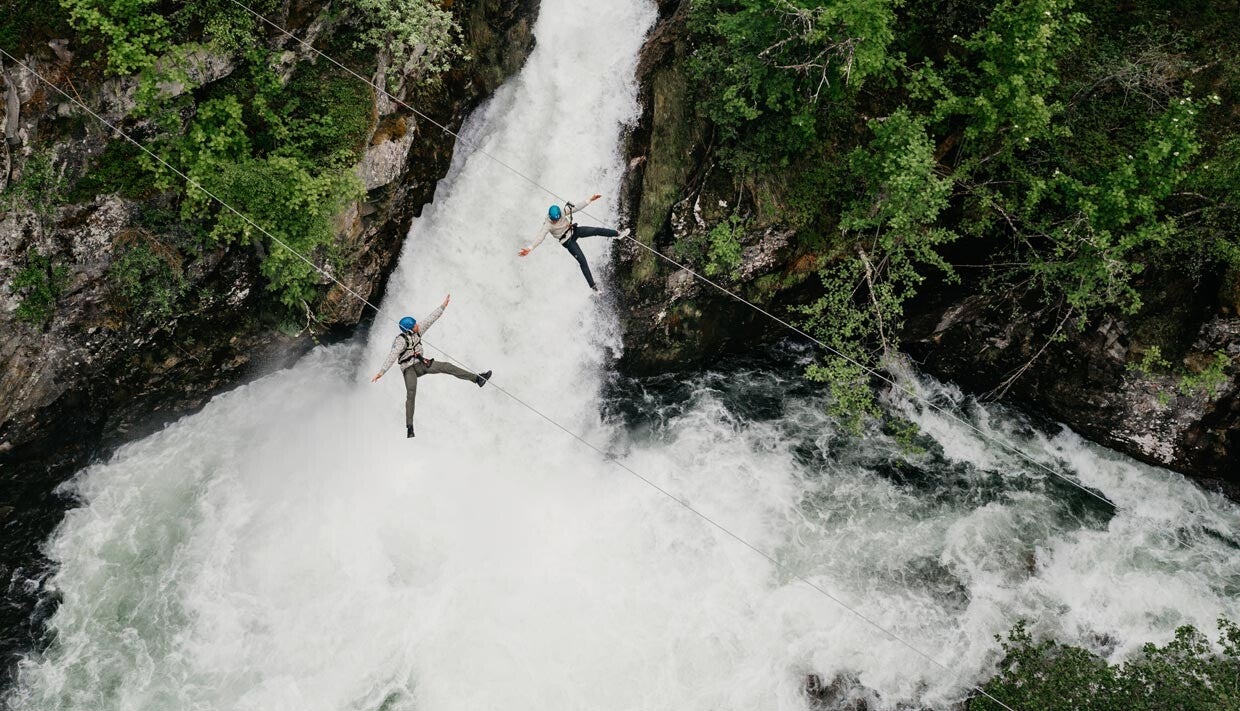
Photo: www.geirangerfjord.no
Geiranger: Through Water and Sound
In Geiranger, water takes over the story. The Nature Park consists of four double, parallel zipline sections that cross the Geiranger River three times and pass above a waterfall. The setting belongs to the West Norwegian Fjords landscape recognised by UNESCO.
Here, nature is not simply a photogenic background. It surrounds the body. The river rushes beneath the cable, the waterfall fills the gorge with noise and spray, and the vegetation draws close around the water. The landscape is experienced through several senses at once: sight, sound, speed, movement and the sudden awareness of height.
This is why an experience so easily labelled an “adrenaline activity” can become something richer. Fear has a remarkable ability to pull us into the present. Suspended above a torrent, we are not checking a telephone, thinking about an unanswered email or looking at images of places visited by someone else. For once, attention is not divided. We are simply there.
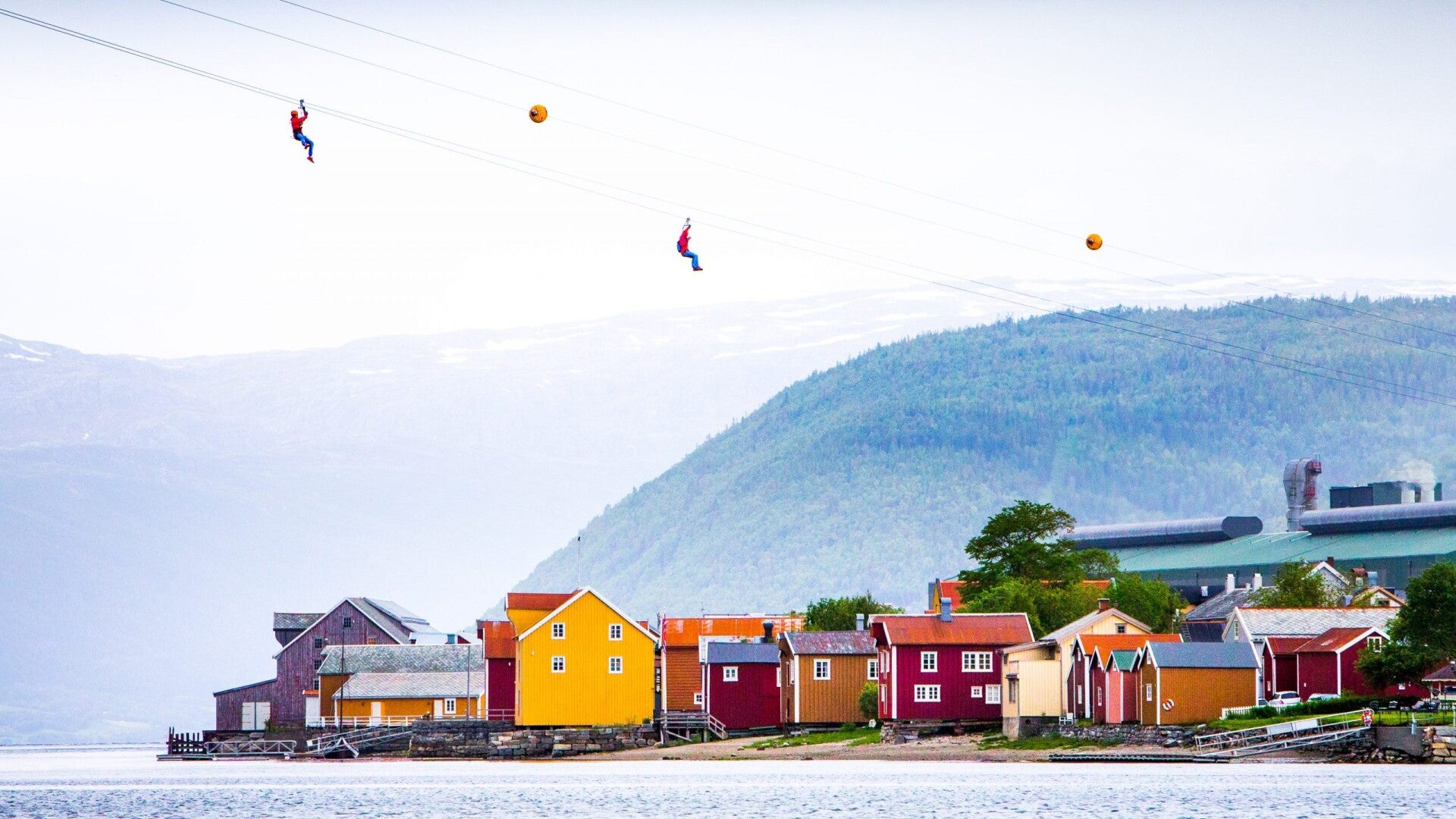
Photo: Hans Petter Sørensen, Faroutfocus / Visit Helgeland
Mosjøen: From the Mountain into the Town’s History
Continuing north into Nordland, the zipline at Mosjøen offers a different kind of transition. Its approximately 700-metre route begins on the mountain around 70 metres above the town, crosses the Vefsna River and ends near the historic centre, in the gardens of Fru Haugans Hotel.
The flight moves not away from civilization, but towards it. On one side lie the river, mountain and broad Helgeland landscape; on the other, Sjøgata appears with its historic wooden buildings. Nature and human history meet beneath the same cable.
There is something fitting about landing in a place shaped by generations of life beside the river. Travel does not always require us to escape the world completely. Sometimes, changing the point from which we see it is enough.
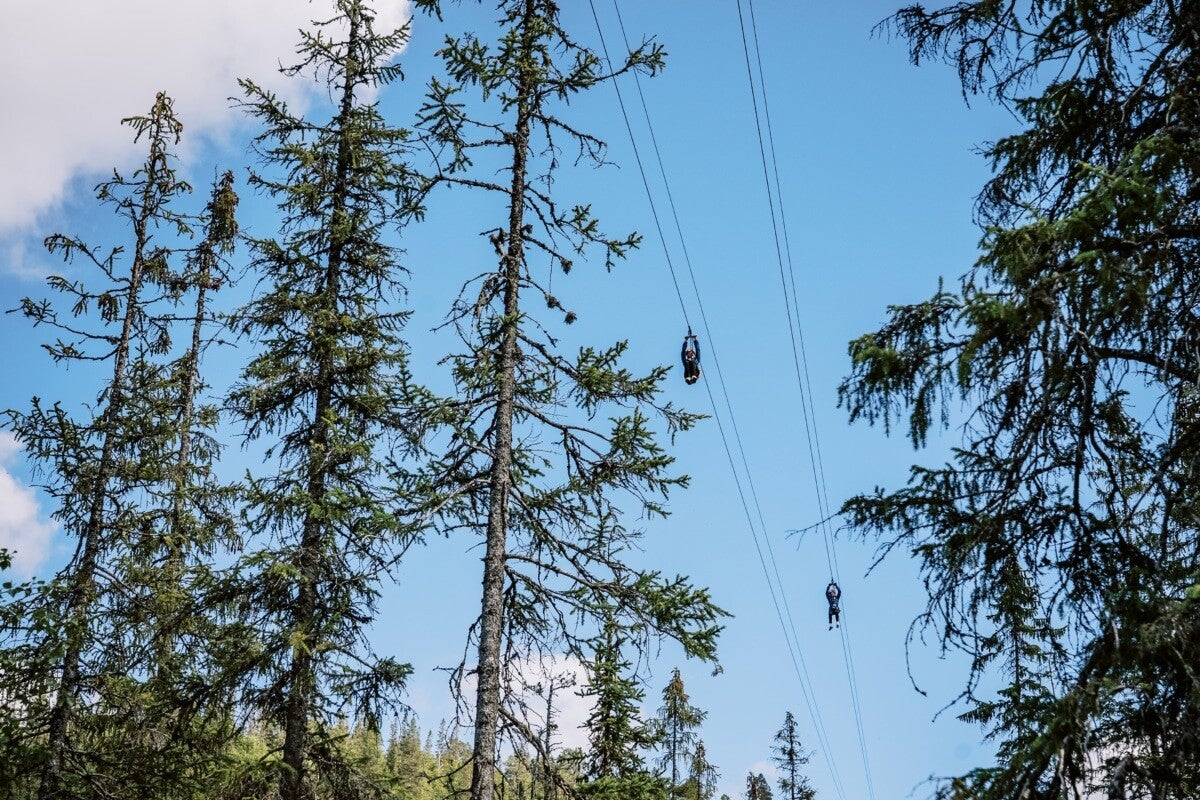
Photo: www.rypetoppen.no
Rypetoppen: A Journey Through the Forest
Near Meråker in Trøndelag, Rypetoppen Adventurepark replaces the single dramatic flight with a succession of smaller crossings. Set among forest, mountain and water, the park contains 28 ziplines. Some pass over the water in front of Brudesløret, the “Bridal Veil” waterfall, while Kongeørna, introduced in 2026, stretches for 670 metres and is described by the operator as the park’s highest, fastest and most spectacular zipline.
The experience is one of gradual immersion. Each section rearranges the landscape: branches give way to rock, rock to water, water to open air and open air to solid ground. Instead of one overwhelming panorama, the forest reveals itself through a series of changing perspectives. Moving through it becomes a small lesson in how differently a place can be perceived when our usual relationship with the ground is interrupted.
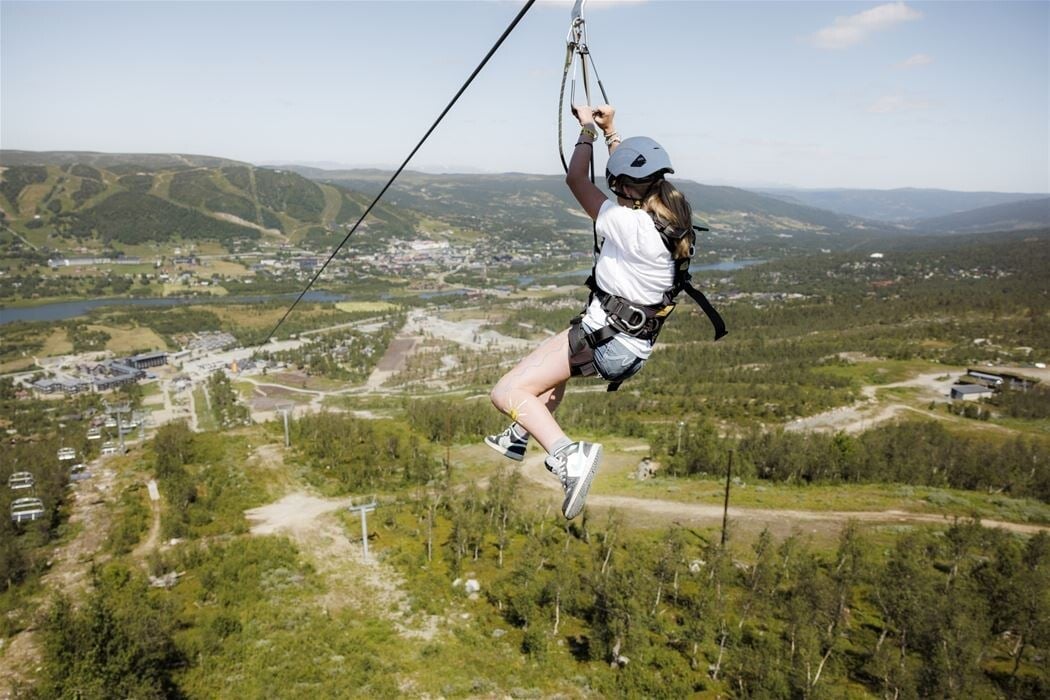
Photo: www.skigeilo.no
Geilo: Across the Open Mountain
At Geilo, the fjords disappear and the mountain plateau becomes the protagonist. The summer zipline descends for approximately 1,100 metres towards the adventure park, with views in the direction of Hallingskarvet and the open spaces of Hardangervidda.
This is a different Norway from the narrow, steep-sided fjords of the west. Here, the emotion comes from spaciousness. Rock, wind, lichen and changing light form a landscape that seems to exist on another timescale, one in which the urgency of city life becomes difficult to remember.
We cross that space in a matter of minutes. The mountain remains, indifferent to our speed.
Holmenkollen: Above the Geometry of the City
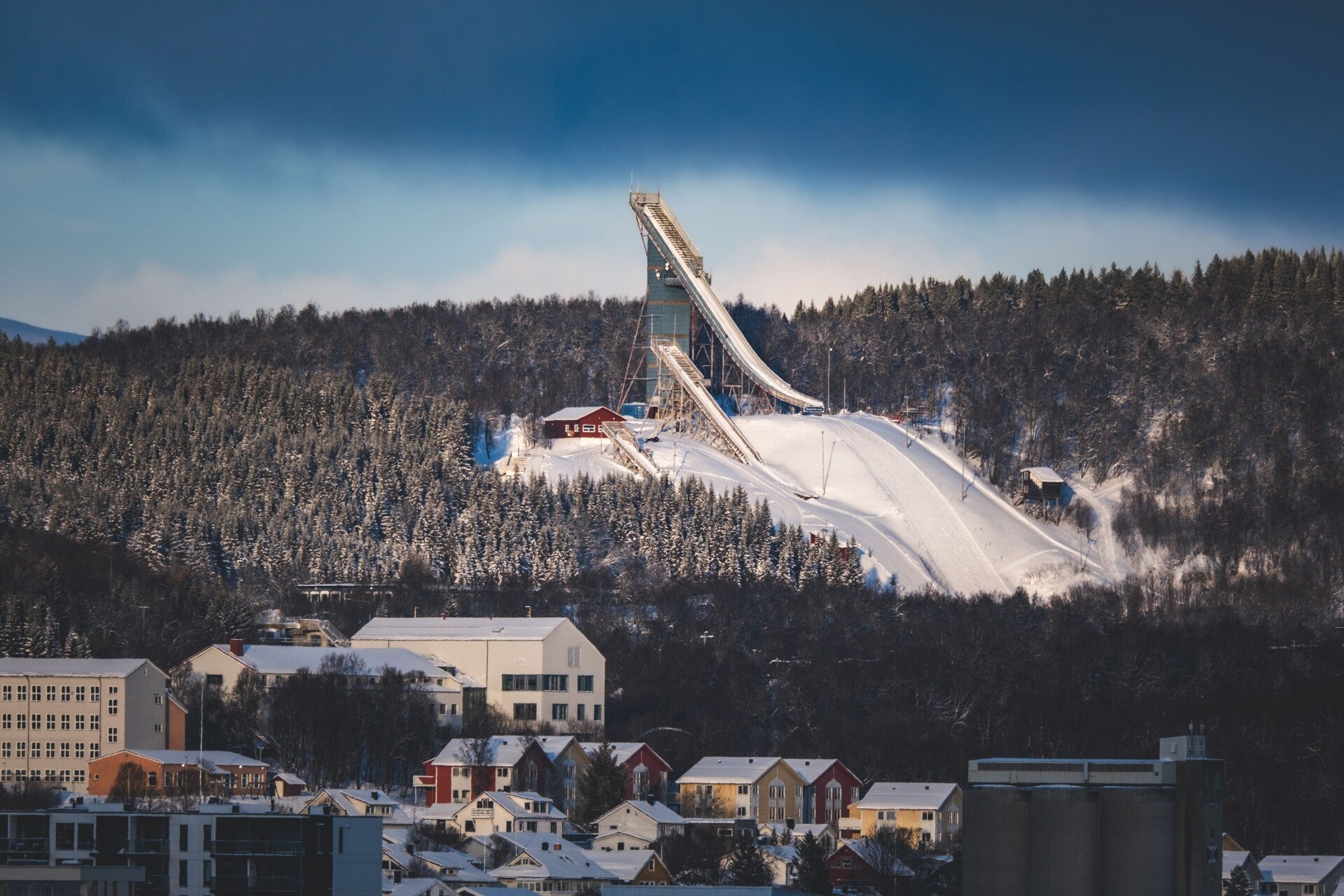
The journey ends in what might seem the most unlikely place: Oslo. After all, rediscovering the sensation of flight does not always require a remote valley or an isolated fjord.
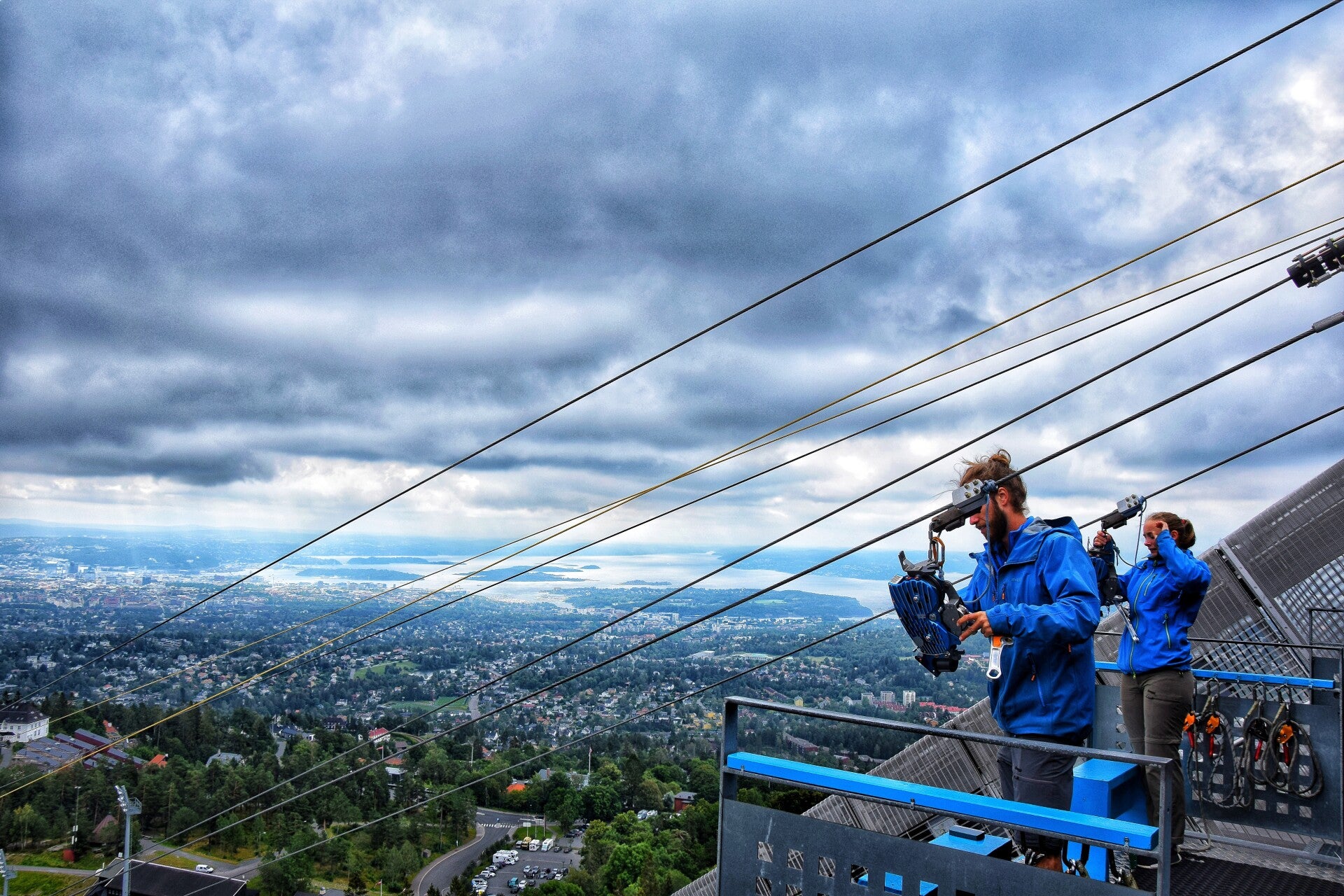
From the tower of the famous Holmenkollen ski jump, Kollensvevet descends for 361 metres, covering a vertical drop of 107.5 metres and opening a wide view across the Norwegian capital.
Below, the city returns: streets, buildings, traffic and all the familiar geometry of modern life. Yet for a few seconds, we are no longer enclosed within it. We are looking down upon the very maze from which we wished to escape, held safely above it by a single line.
We live in an age in which much of our experience is increasingly mediated. We look at mountains through screens and seem to know places before arriving because we have already seen thousands of photographs. We measure steps, altitude, heart rate, distance and performance. We photograph what we are experiencing while we are still experiencing it.
Slowly, we risk losing one of our oldest and simplest capacities: wonder.
Norwegian nature teaches the opposite. A waterfall does not need to be improved. A fjord does not need to be hurried. A mountain does not ask to be conquered. We can only approach, listen, pass through and, occasionally, entrust ourselves to it.
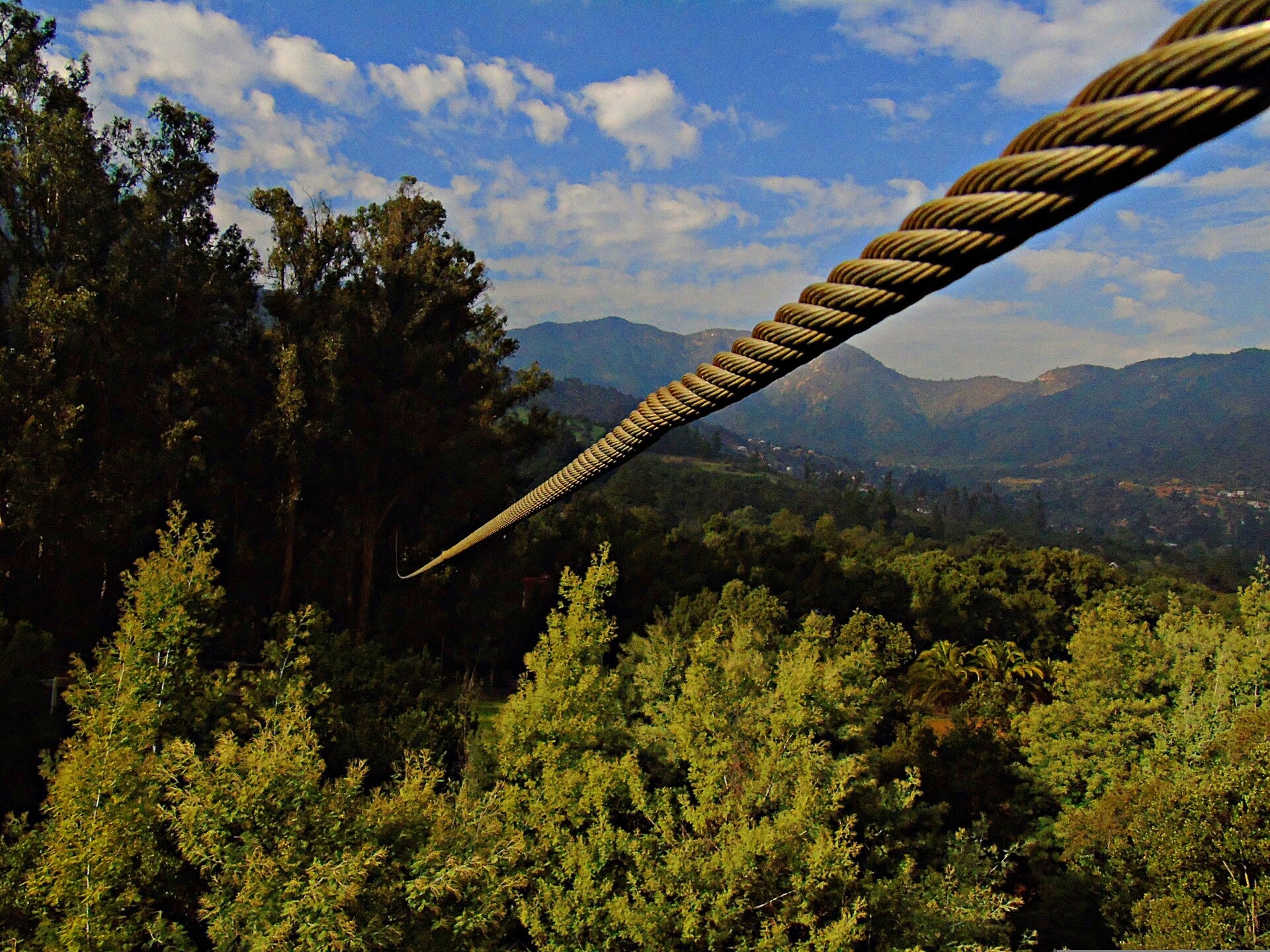
A zipline paradoxically embodies both sides of the modern world. It is a work of technology, steel, harnesses, pulleys, calculations and safety systems, yet all that technology exists to return us, for a few seconds, to something elemental: wind, emptiness, water, mountain, body and fear.
Perhaps the freedom we feel during that brief flight is only simulated. We remain attached to a cable. But the experience can remind us of a more important freedom: the freedom to step away, if only temporarily, from automatic behaviour, constant connection and the modern conviction that everything must be controlled, occupied and put to use.
Nature still contains spaces in which we can feel small. To feel small in the presence of something immeasurably greater does not necessarily mean feeling powerless. Sometimes, it means feeling free.
Daedalus understood this two thousand years ago. Power may close the roads and control the sea, but an unexpected direction always remains.
“At caelum certe patet.”—The sky, at least, remains open.
In Norway, it is still possible to remember this. Sometimes, all it takes is the courage to hang by a thread and, for a few moments, leave the earth beneath us.