Photo: Leonardo Sani
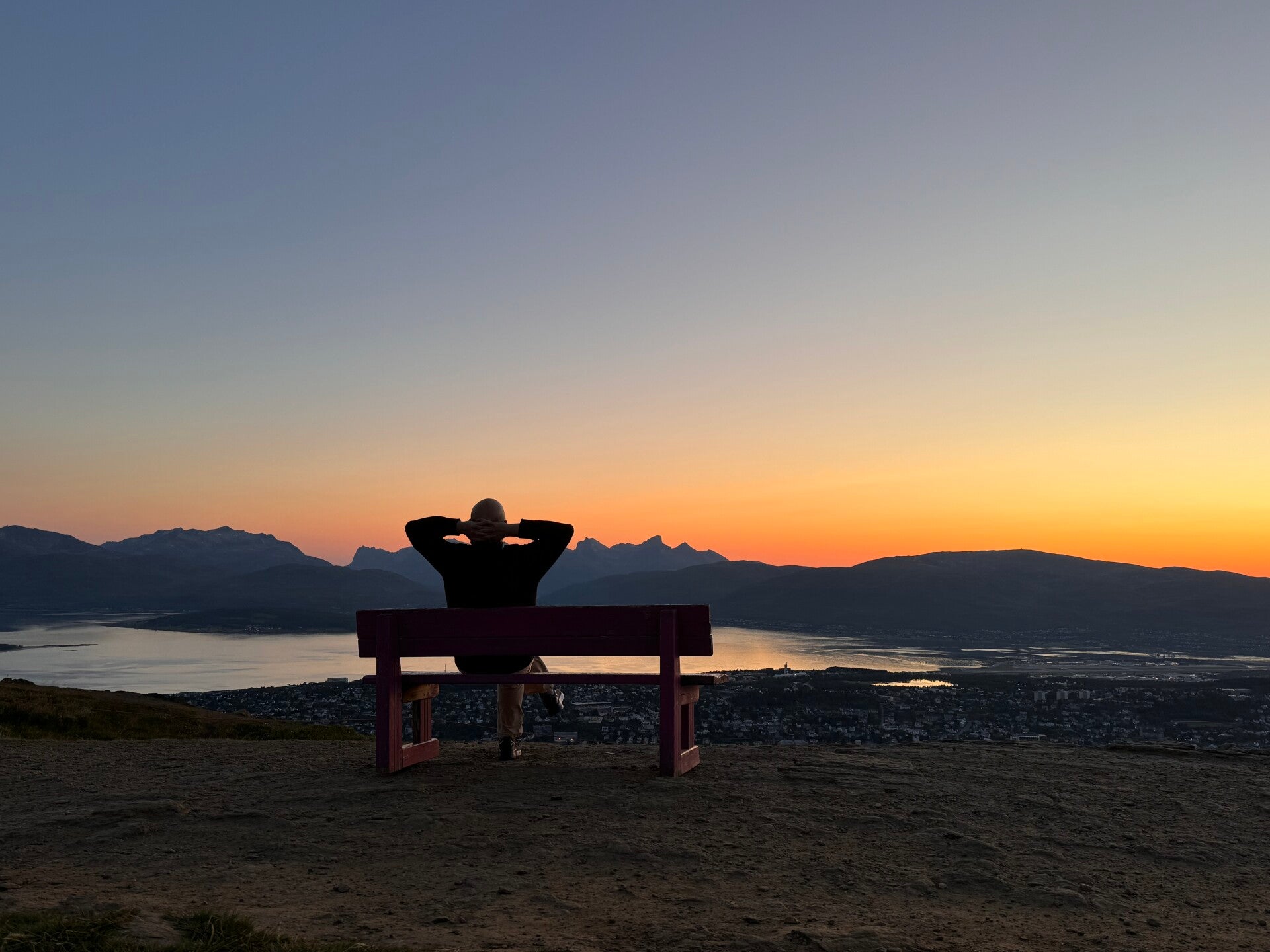
Many people are drawn to height. They chase views that take your breath away, horizons that stretch until they fade into the distance. In Norway, that desire feels easy to fulfill. You step into a cable car, it quietly leaves the station, and soon you’re gliding above fjords and valleys in near silence. The ascent feels light, almost effortless. It’s an invitation not just to go up, but to see the world differently.
Yet some heights ask for your full attention. As the cabin rises into the clear northern air, trust becomes something you feel, not something you think about. Here, the wind can shift quickly, and snow can reshape the landscape in a matter of hours. Safety isn’t taken for granted. It’s built on careful checks, invisible details, and thoughtful decisions made long before any risk appears. In these remote regions, between plateaus and fjords, there’s no room for approximation. And that’s exactly why each ride feels so calm, so natural.
Many of these cable systems weren’t created for visitors. They were built out of necessity, connecting isolated communities where geography made everyday life difficult. As early as the first decades of the twentieth century, cable cars and funiculars provided access and continuity in places that would otherwise remain cut off. They were designed to last, not to impress. Even today, despite modern technology, they carry that same spirit: quiet reliability, shaped over time. You don’t notice it directly, but you feel it in every detail that simply works.
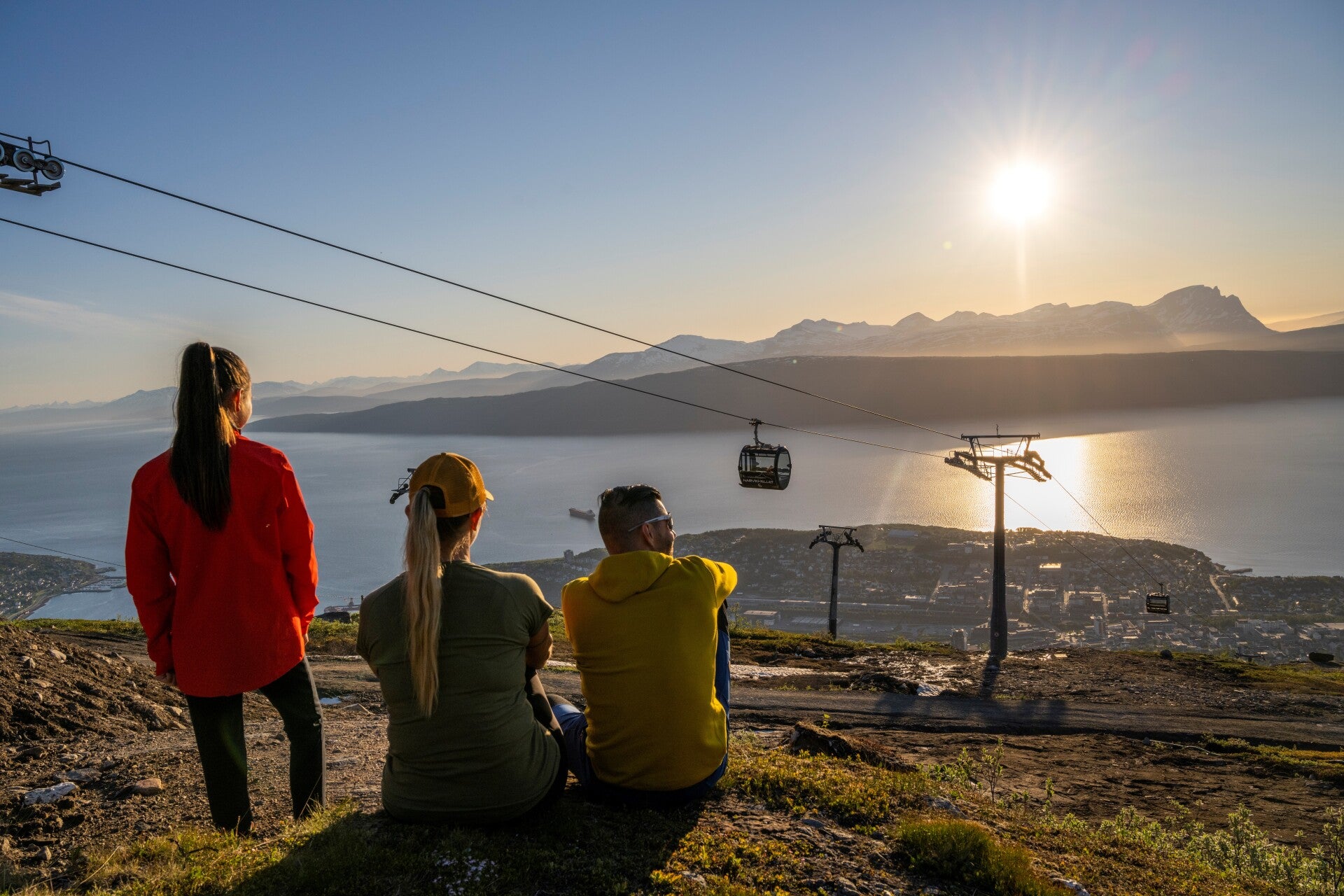
Photo: Rune Dahl / www.visitnarvik.com
And as you rise, suspended between rock and sky, something more subtle happens. The landscape begins to open up and make sense in a new way. Fjords curve with quiet precision, villages shrink into small, scattered points, and the mountains reveal their essential form. It’s a slow, measured shift. You’re not really leaving the ground behind, just learning how to see it differently.
By the time you return to the valley, something has changed. The same trails, the same houses, even the smallest details feel new. Height has given you distance, and distance brings clarity.
In the next section, you’ll find a curated selection of Norway’s most scenic cable cars and gondolas. Elegant, high-altitude lifts that carry you effortlessly into some of the country’s most striking and unforgettable landscapes. Taken together, these lifts do more than move people upward. They remove the barrier of steep terrain while preserving the feeling of elevation itself. You arrive quickly, almost effortlessly, and that gives you space to notice the movement of weather, the structure of the land, and the silence that follows when the cabin comes to a stop.
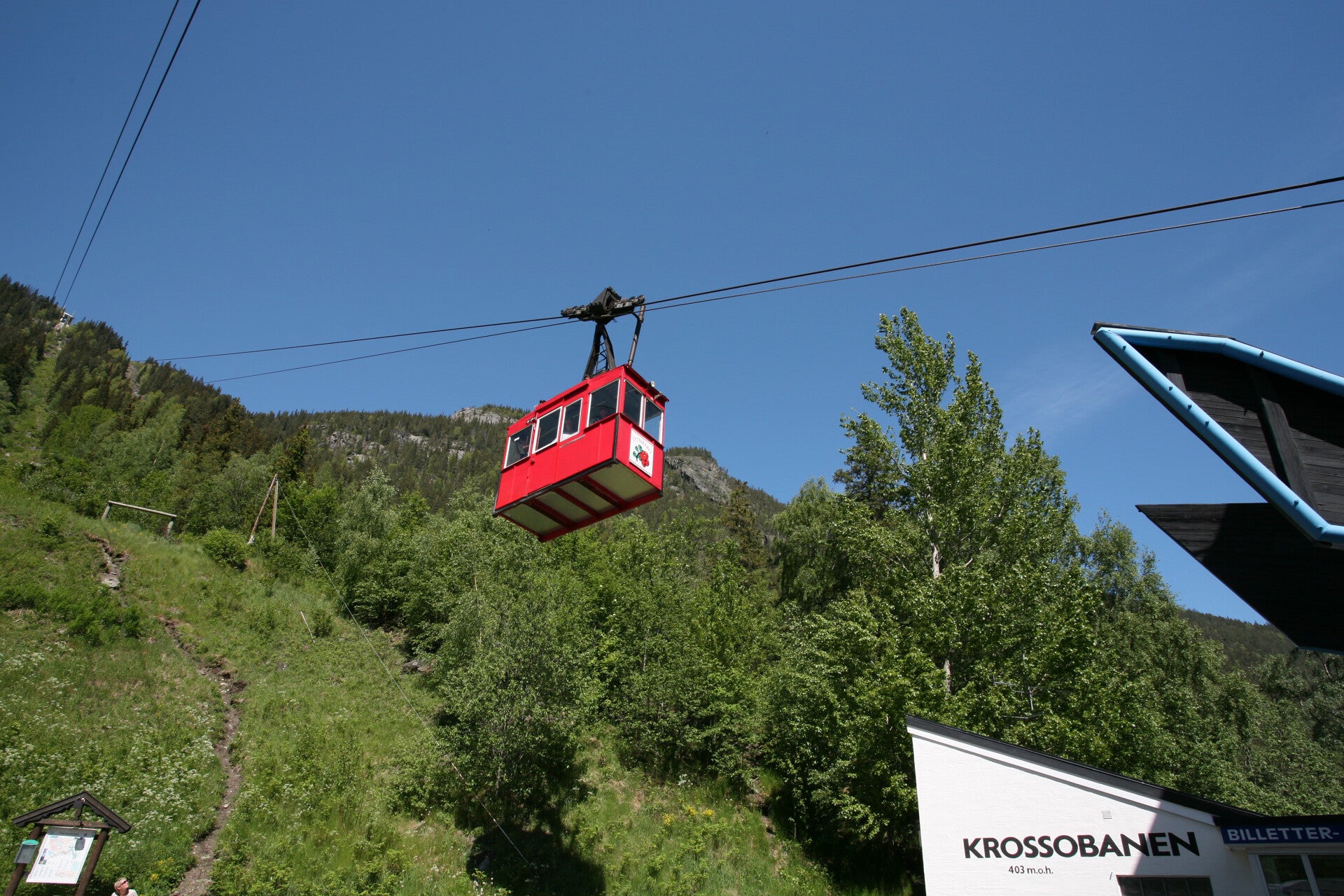
Photo: Besse / https://creativecommons.org/licenses/by-sa/3.0/
Krossobanen, Rjukan
The story begins in Rjukan, a narrow industrial valley where winter once meant months without direct sunlight. When the Krossobanen opened in 1928, it was built for workers, not tourists, funded by Norsk Hydro as a way to improve daily life in a town shaped by heavy industry and steep terrain. Within minutes, it carried people from the shadowed streets to the sunlit plateau above, offering something as simple and essential as daylight. It was the first cable car in Northern Europe, and at the time, a bold piece of engineering designed for function over flair.
The ride itself is short, just a few minutes, but it still follows the same line up the mountainside, climbing roughly 500 meters from the valley floor. Today, the cabins have been modernized, yet the experience remains grounded in its original purpose. The ascent is steady and quiet, almost understated, as the town slips out of view and the valley walls tighten around you.
Then, at the top, everything opens. The Hardangervidda plateau stretches wide and exposed, a sharp contrast to the enclosed world below. There’s a simple café and open viewpoints, but the real draw is the space itself. In summer, it’s a place for unhurried walks across open terrain. In winter, it becomes a starting point for cross-country skiing under a vast sky.
It’s less about spectacle and more about transition. From shadow to light, from confinement to openness. What stays with you is that first moment at the top, when the sky finally feels within reach after being hidden by steep valley walls below.
Krossobanen is currently out of service while undergoing a comprehensive and necessary upgrade, with reopening expected in the next few years.
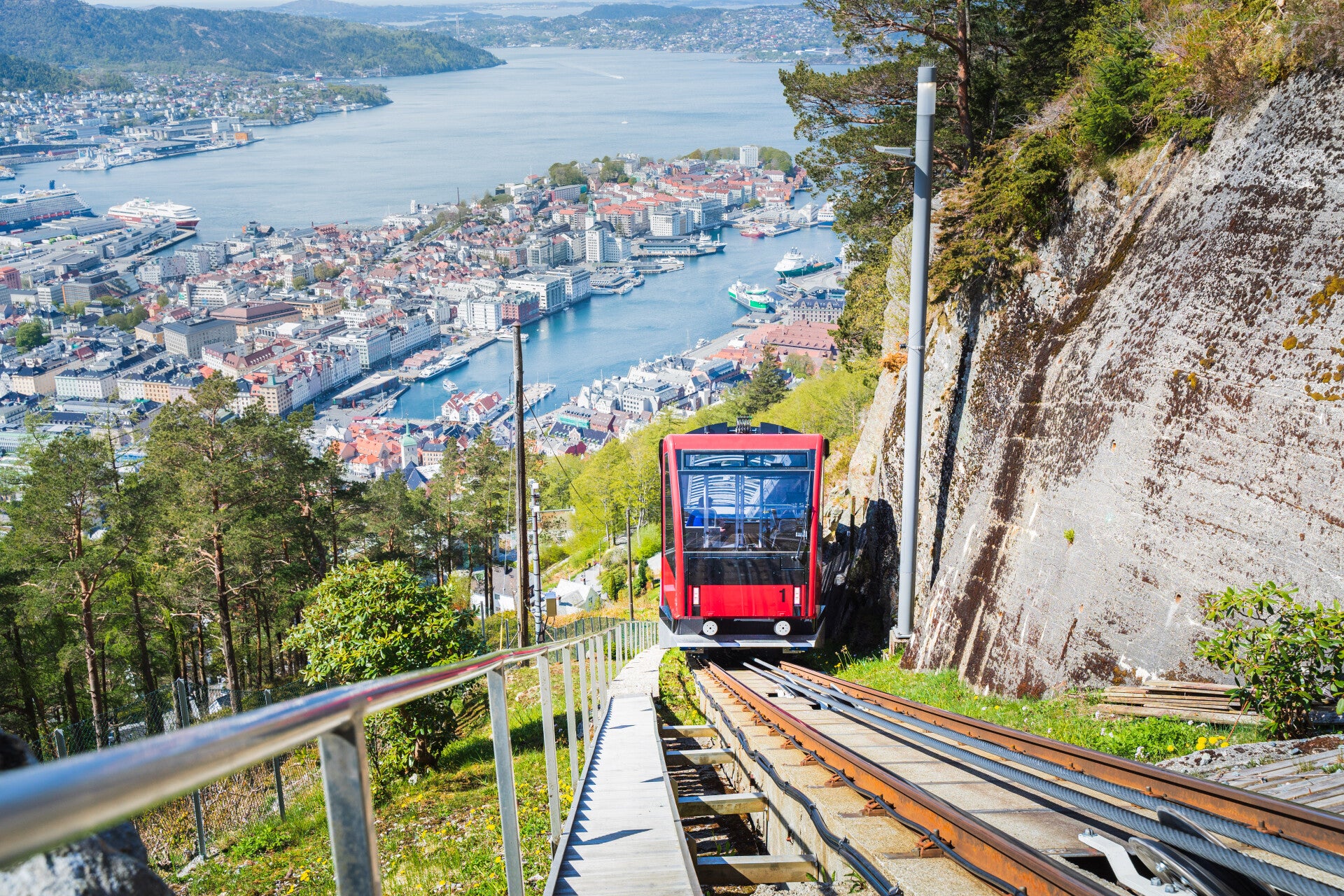
Photo: Casper Steinsland / www.visitbergen.com
Fløibanen, Bergen
In Bergen, the Fløibanen has been part of the city’s rhythm since 1918. It begins just behind the historic harbor area of Bryggen and climbs steadily toward Mount Fløyen, following a route that feels as familiar to locals as any street below. Originally powered by a water-balance system before later electrification, it has quietly evolved with the city while keeping its role unchanged: connecting everyday life with the landscape that surrounds it.
What makes this funicular special is how naturally it links urban and natural spaces. In just six or seven minutes, the car travels from the noise of the waterfront through residential hillsides and into the forest. Families with strollers, hikers, and visitors all share the same short ride, which runs frequently throughout the day, year-round.
At the top, the atmosphere is open and easygoing. There are well-marked trails that suit every pace, panoramic viewpoints over Bergen and the surrounding fjords, and small lakes and wooded areas that invite you to slow down. A café and simple facilities make it easy to stay longer than planned.
In summer, it’s a place for unhurried walks, quiet picnics, and long evenings as the light lingers over the city. In winter, especially after fresh snowfall, it becomes a local gathering spot for sledding and simple outdoor life. It’s not a grand or overwhelming experience, but that’s exactly the point. The Fløibanen is part of Bergen’s everyday rhythm, a gentle, reliable way to step out of the city and into nature without ever really leaving it behind.
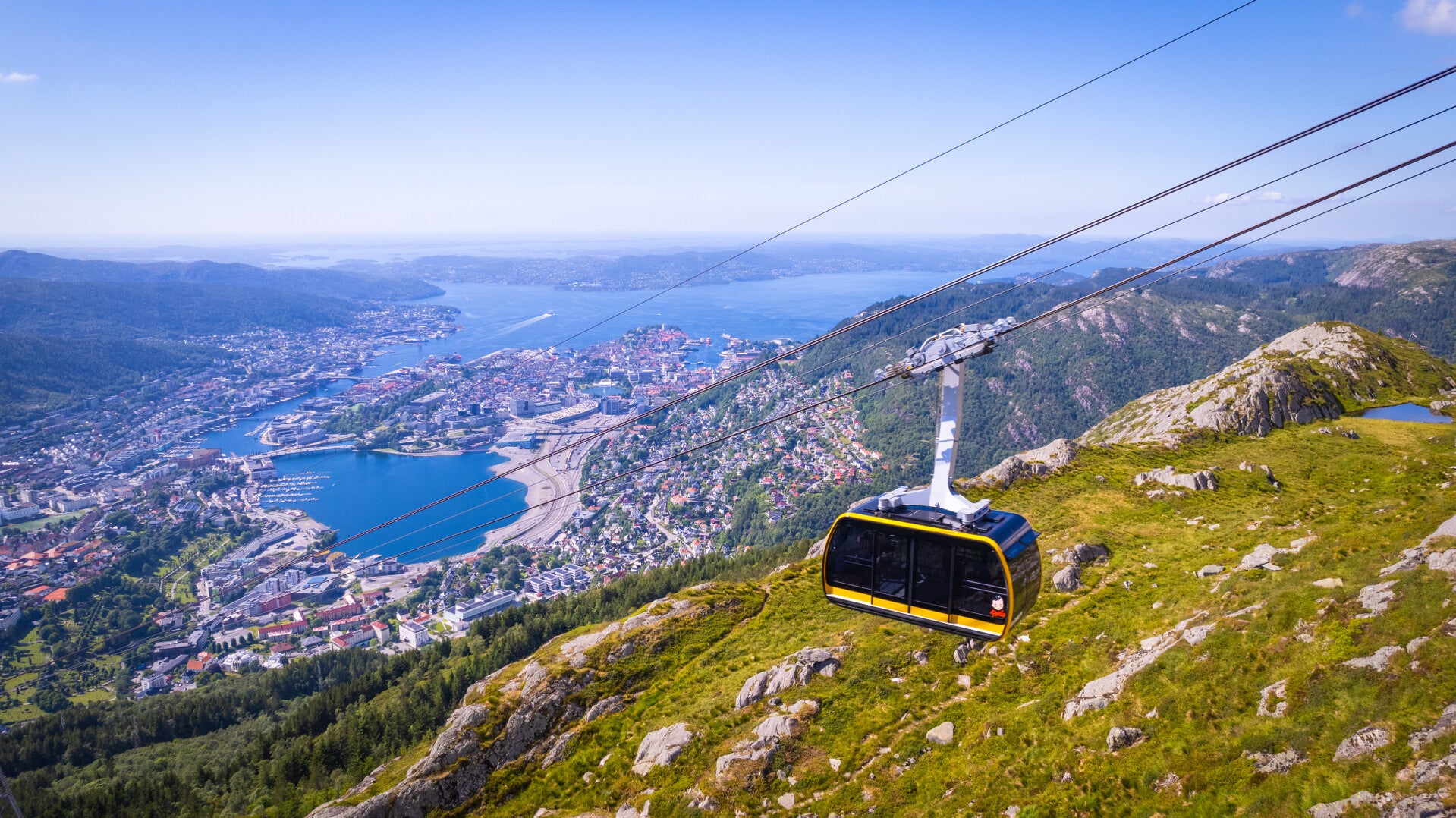
Photo: Ulriken643
Ulriken Cable Car, Bergen
Ulriken, the highest of Bergen’s seven mountains at 643 meters, offers a broader, more open perspective on the city and its surroundings. The cable car, recently upgraded with larger, more modern cabins, rises quickly from the outskirts of Bergen, lifting you above neighborhoods, forests, and steep rock faces in just a few minutes. The shift feels immediate. One moment you’re in the city, the next you’re suspended in open air, with the coastline, scattered islands, and inland ridges unfolding in every direction.
There’s a different quality to Ulriken compared to Fløyen. The air feels cooler, more exposed, and the landscape less sheltered. At the top, the terrain opens into a rugged plateau, shaped by weather and distance rather than proximity to the city. It’s here that the well-known Vidden trail begins, a long, high route stretching roughly 13 kilometers across open ground toward Mount Fløyen. Many visitors take the cable car up and then spend several hours walking this path, moving through a landscape that feels remote despite its closeness to Bergen.
The summit itself is simple but well set up. There’s a café and restaurant where you can sit by the windows and watch the weather shift.
In winter, Ulriken takes on a quieter, more solitary character. Snow and mist often soften the terrain, and the number of visitors drops. The same views are there, but they feel more distant, more introspective. It becomes less about movement and more about stillness.
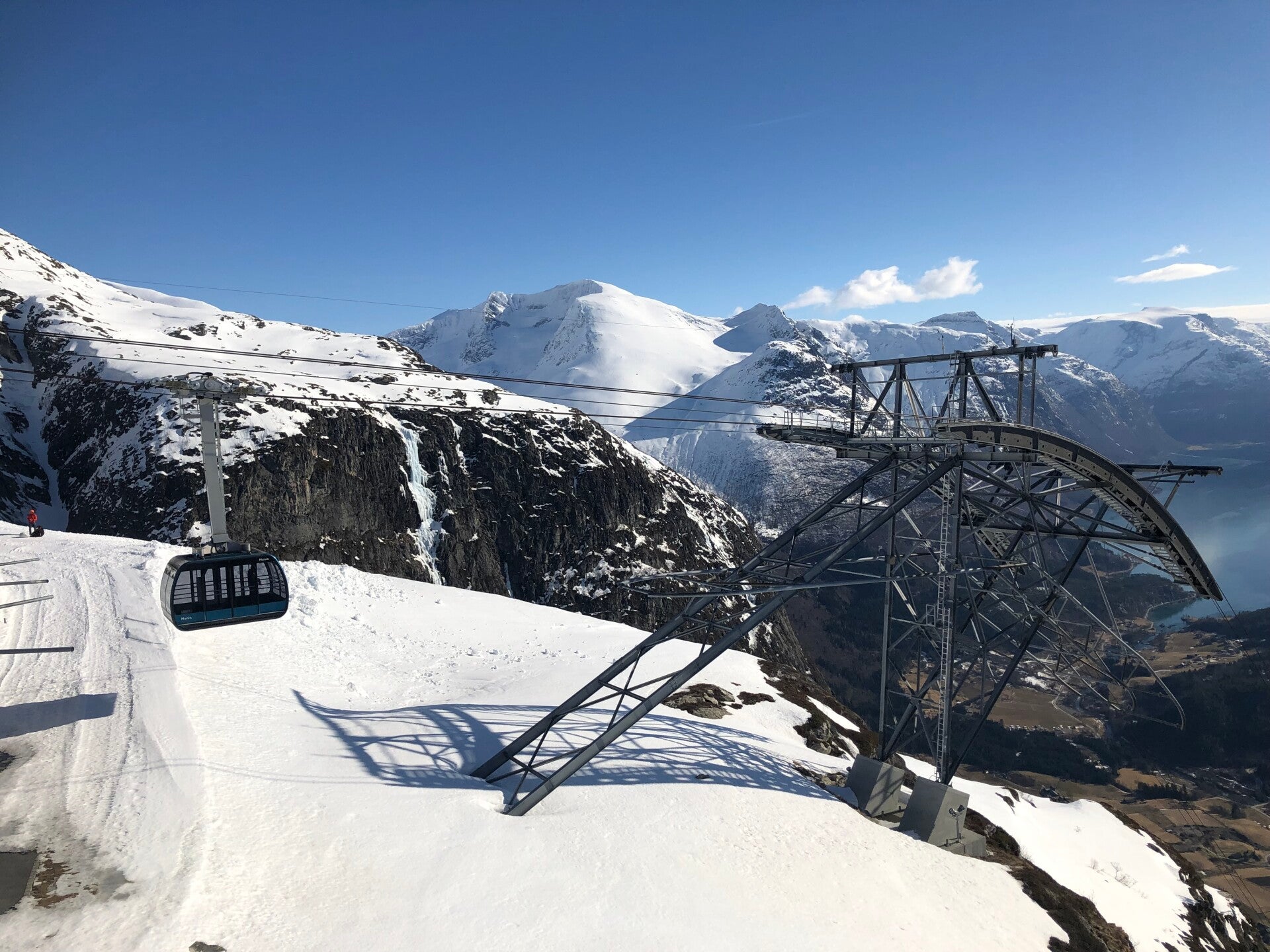
Photo: Mathia Pacenti / ©WanderNorway
Loen Skylift, Nordfjord
The Loen Skylift is one of the most striking cable cars in Norway, both for its setting and the sheer vertical distance it covers. It rises almost directly from the edge of the Nordfjord to the top of Mount Hoven, climbing about 1,011 meters in just five minutes. From the moment the cabin leaves the station, the ascent feels steep and immediate. Large glass panels wrap around the gondola, keeping your focus outward as the ground drops away and the fjord comes into full view.
Below, the landscape is layered and precise. The Nordfjord narrows as it stretches inland, its surface often calm and reflective. Small farms sit close to the shoreline, connected by narrow roads, while waterfalls trace pale lines down the mountainsides, especially in late spring and early summer when the snow begins to melt. The scale becomes clearer the higher you go, as each element settles into place.
At the top, Mount Hoven opens into a wide, accessible plateau with a well-developed network of trails. Some are short and easy, leading to viewpoints just a few minutes from the station. Others extend further into the surrounding mountains, offering longer hikes with increasingly remote views. A restaurant at the summit provides a place to pause, with large windows that frame the fjord far below.
In summer, the area becomes a starting point for a range of outdoor activities. Hikers move out along the ridgelines, and paragliders often launch from the slopes, dropping into the valley in slow, controlled arcs.
One of the most distinctive additions to the experience around Loen Skylift is the Via Ferrata route that climbs the steep mountainside directly above the fjord. It starts close to the valley station in Loen and follows the rock face in a series of fixed cables, iron rungs, and exposed ledges, gradually gaining height toward Mount Hoven. The Via Ferrata is often done as a half-day or full-day guided experience, and it is most popular in the summer months when the rock is dry and conditions are stable.
In winter, the same terrain shifts into something quieter and more subdued, used for snowshoeing and ski touring across open, snow-covered ground.
The seasons change the experience, but the defining element remains the same: a strong, constant sense of height and exposure.
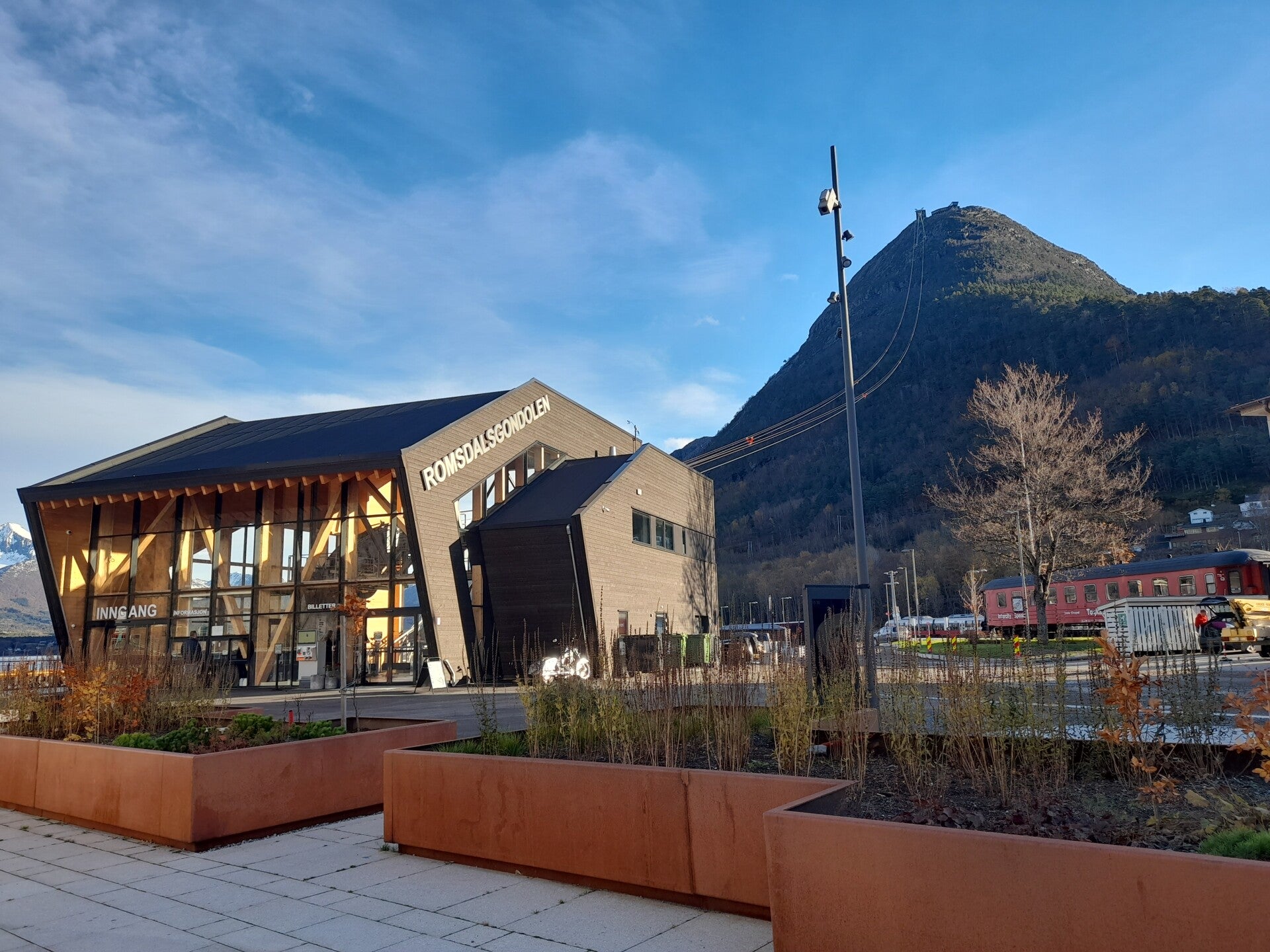
Photo: Gran / https://creativecommons.org/licenses/by-sa/4.0/
Romsdalsgondolen, Åndalsnes
Åndalsnes is often called the mountaineering capital of Norway, and the Romsdalsgondolen reflects that identity in a direct, physical way. Opened in 2021, it connects the town center with the ridge of Nesaksla, rising around 700 meters in just a few minutes. The departure point is right by the Rauma River, so the shift from valley floor to mountain happens quickly and without transition.
The ride itself is smooth and quiet, but the landscape it reveals is anything but soft. The Romsdal valley is steep, narrow, and sharply defined, shaped by some of the most dramatic peaks in the country. Among them is Trollveggen, the Troll Wall, one of Europe’s tallest vertical rock faces, rising almost sheer from the valley floor.
At the top station on Nesaksla, the view opens in multiple directions. On one side, the valley stretches out with the Rauma River cutting through it. On the other, jagged peaks rise abruptly, creating a landscape that feels dense and powerful rather than wide and open. A viewing platform extends the perspective outward, making it easy to take in the scale without needing to hike further.
In summer, the gondola becomes a natural starting point for some of Norway’s most well-known hikes. The Romsdalseggen ridge, in particular, draws experienced hikers with its exposed sections, narrow paths, and continuous views over the valley and surrounding peaks. Even shorter walks around Nesaksla offer a strong sense of the terrain without requiring a full-day commitment.
In winter, the atmosphere shifts. The same slopes attract ski tourers who move beyond the prepared areas into deeper, more demanding terrain. The number of visitors drops, and the landscape feels quieter, but no less intense.
At the summit, a restaurant with wide windows looks directly out over the valley, offering a place to pause and watch the light change across rock and snow.
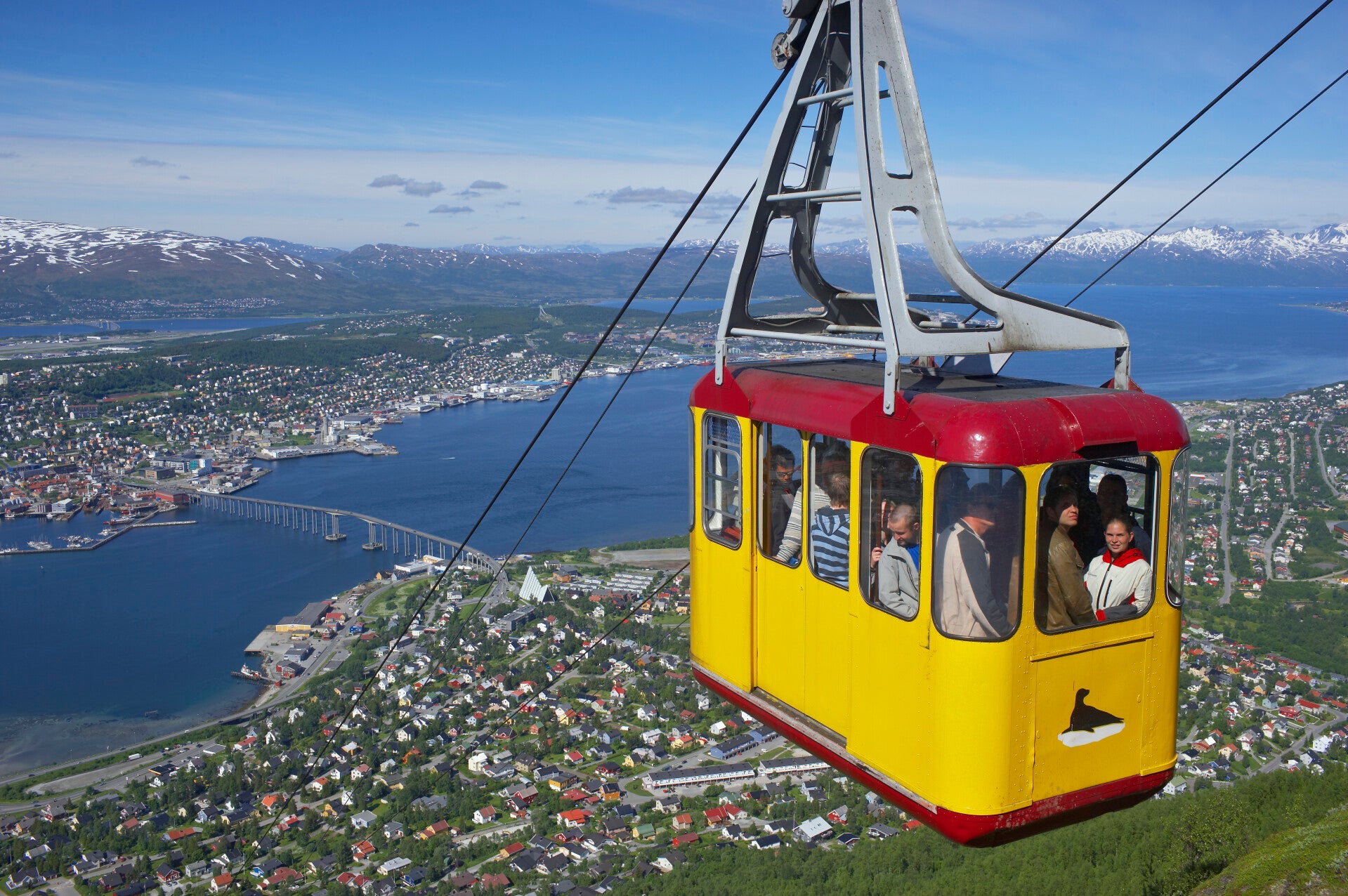
Photo: Bård Løken / www.nordnorge.com
Fjellheisen, Tromsø
In Tromsø, the Fjellheisen cable car offers a distinctly Arctic perspective, shaped as much by light as by landscape. It runs from the mainland side of the city up to the ledge of Storsteinen, about 420 meters above sea level. The ascent is short but steep enough to create a clear sense of separation from the town below.
As the cabin rises, Tromsø reveals its layout in full. The island sits centered between fjords, linked by bridges, with snow-covered peaks stretching out in the distance. From the top, the view feels open yet defined, with the city, sea, and mountains all clearly visible at once. A viewing terrace extends along the edge, and a café and restaurant offer a place to sit and take it in without rushing.
What truly sets Fjellheisen apart is how dramatically the experience changes with the seasons. In summer, the midnight sun creates a continuous, diffused light that softens everything. Shadows fade, time feels less structured, and people tend to stay longer than planned, watching the subtle shifts in color as the sun circles without setting.
In winter, the atmosphere turns inward. Darkness settles in for much of the day, and the landscape becomes quieter, more reflective. Snow covers the ground and catches what little light there is, giving the surroundings a muted glow. On clear nights, the plateau becomes one of the most accessible places to watch the northern lights. When they appear, they move slowly across the sky in green and sometimes purple bands, drawing everyone’s attention upward.
The cable car runs year-round, but it offers two very different experiences. One shaped by endless light, the other by deep darkness.
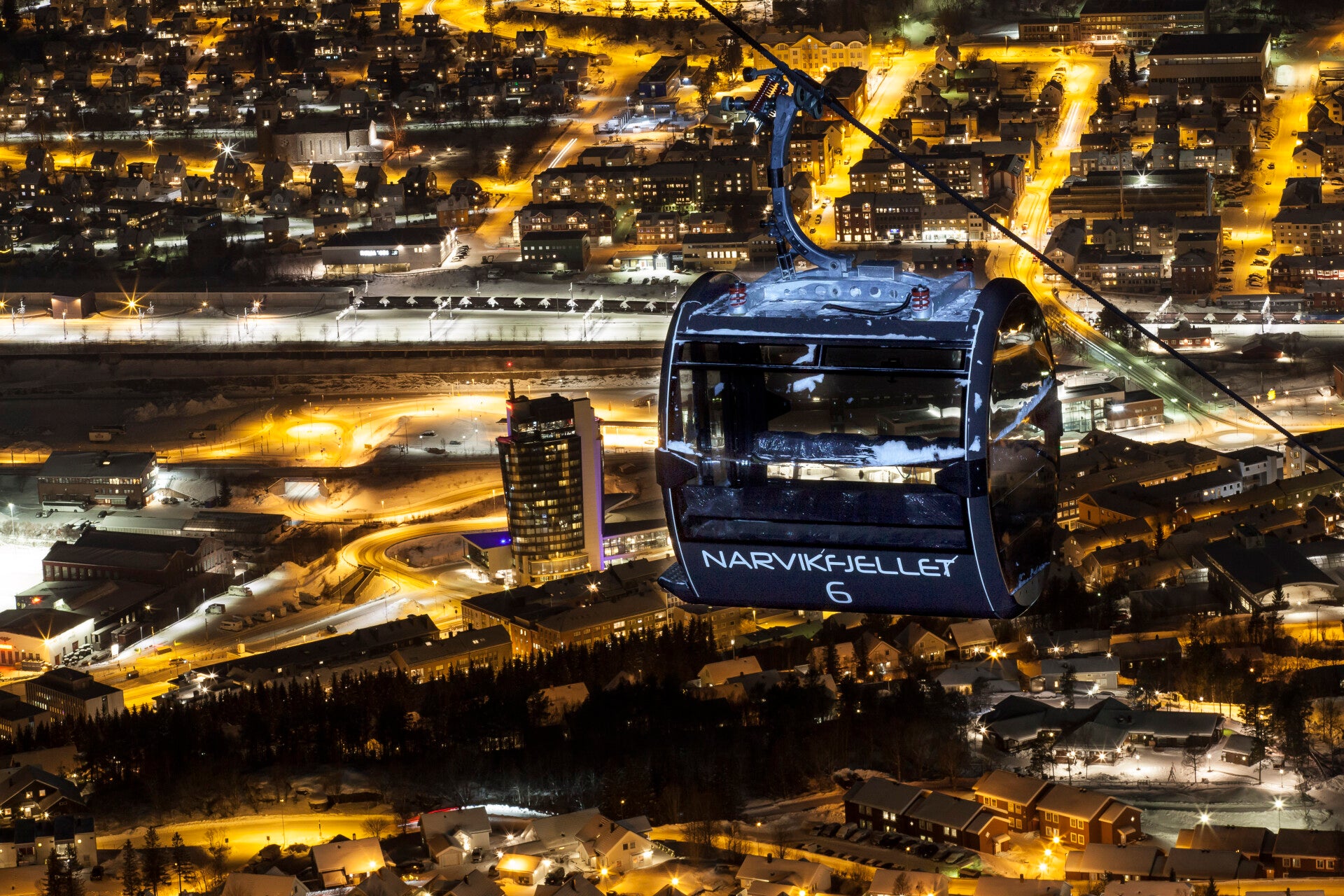
Photo: www.visitnarvik.com
Narvikfjellet Gondola, Narvik
The Narvikfjellet Gondola brings together sea and mountain in a way that feels distinctly Norwegian, both in scale and contrast. It begins close to the Ofotfjord and climbs steeply toward the slopes of Narvikfjellet, rising to around 650 meters above sea level. The transition is quick and clear. One moment you’re near the water, the next you’re in open alpine terrain, with cooler air and a wider horizon.
As the gondola ascends, the view stretches outward across the Ofotfjord, often dotted with ships, and toward the surrounding peaks that frame the region. The setting has a certain clarity to it. The lines between sea, rock, and sky feel sharply defined, especially on bright days when visibility reaches far into the distance.
In winter, this becomes one of Norway’s more distinctive ski environments. Narvikfjellet is known for its steep terrain and reliable snow, but what sets it apart is the constant presence of the fjord below. Skiing here means moving down long runs while looking out over open water, something you rarely experience at this scale. The gondola plays a central role, providing steady access to higher elevations and keeping the mountain connected even when weather conditions shift.
In summer, the landscape softens. Snow recedes, revealing green slopes and a network of trails that lead across the mountain. The midnight sun lingers low over the horizon, casting long, angled light that changes the colors of both the terrain and the fjord below. It becomes a quieter experience, more about movement at your own pace. Hiking, photography, or simply stopping to take in the contrast between water and rock. At the top, simple facilities and viewing areas give you space to pause. There’s no need for much else. The setting does most of the work.
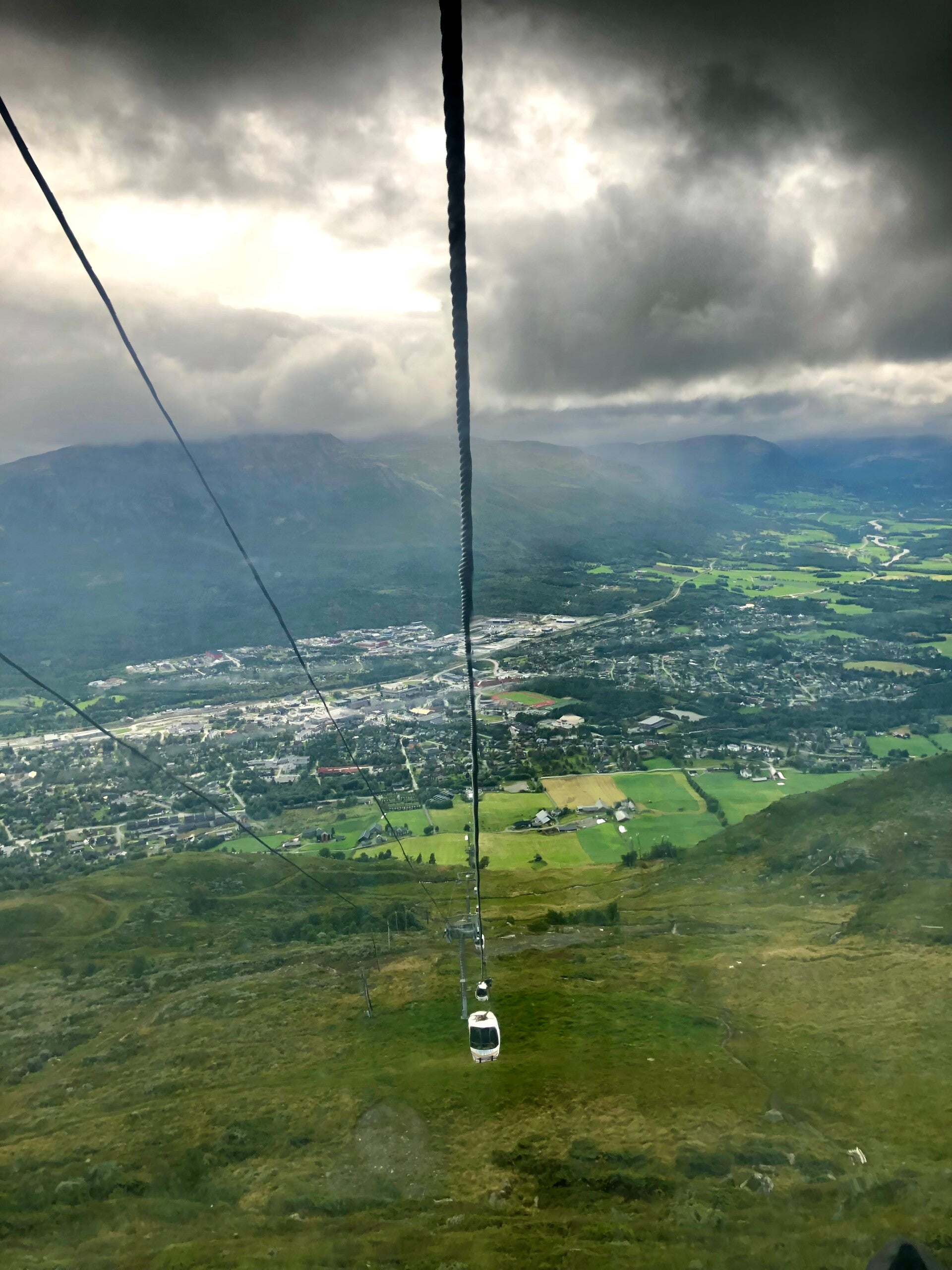
Photo: Mathia Pacenti / ©WanderNorway
Oppdal Summer Gondola, Trøndelag
When spring gives way to summer, the rhythm of Oppdal Ski Center changes. Chairlifts slow down or stop, replaced by gondolas that glide up Hovden. The ascent is steady and quiet, lifting you above forest and open hillsides until the valley begins to spread out below. On clear days, the view stretches far enough that you can pick out the distant shape of Snøhetta, sitting like a pale outline against the sky.
At the top station, the mountain opens into a broad plateau of paths and viewpoints. The restaurant sits here as a natural pause point. Inside, wide windows hold the landscape in place while you eat.
Step away from the station and the mountain begins to unfold in layers. Trails slip behind the summit into open, rolling terrain where everything feels more exposed and unstructured. In summer, the paths cut through grazing land where sheep and cattle move slowly across the slopes. Old ski infrastructure sits quietly in the background, and streams cut thin lines through the ground. If you keep going, longer routes lead deeper into the landscape, including the more demanding walk toward Blåøret, where the sense of distance becomes more pronounced.
The gondola system also brings a different kind of movement to the mountain in summer. Cyclists take the lift up and descend along marked trails, turning the slopes into a repeating rhythm of ascent and ride. Jumps and ramps, built and maintained by volunteers, shape parts of the descent into a flowing line through the terrain. Hikers and riders share the same space, each moving at a different speed, each reading the mountain in their own way.

Photo: Wolfmann / https://creativecommons.org/licenses/by-sa/4.0/
Voss Gondola, Voss
Opened in 2019, the Voss Gondola is the largest one in Northern Europe, but what stands out is how naturally it fits into the journey. It begins at Voss Station, where you can step off a train and, within minutes, be carried upward toward Mount Hanguren. The transition is quick, almost disorienting in the best way. One moment you’re at ground level, surrounded by the everyday movement of a small town, and less than nine minutes later you’re 800 meters above sea level, looking out over still water, layered ridgelines, and a horizon that seems to keep unfolding.
At the top, it opens into something more than a viewpoint. The gondola becomes a starting point, quiet, spacious, and full of possibility. In summer, paths stretch out across the mountain, from short, gentle walks to longer routes for hiking and biking, while paragliders drift above the slopes. In winter, the same space connects directly to Voss Resort, where the shift from arrival to activity happens almost without pause.
The arrival area is designed to feel like a small, self-contained mountain hub rather than just a lookout. Hangurstoppen Restaurant anchors the space, with its high ceilings and large windows drawing your attention straight back out to the landscape.
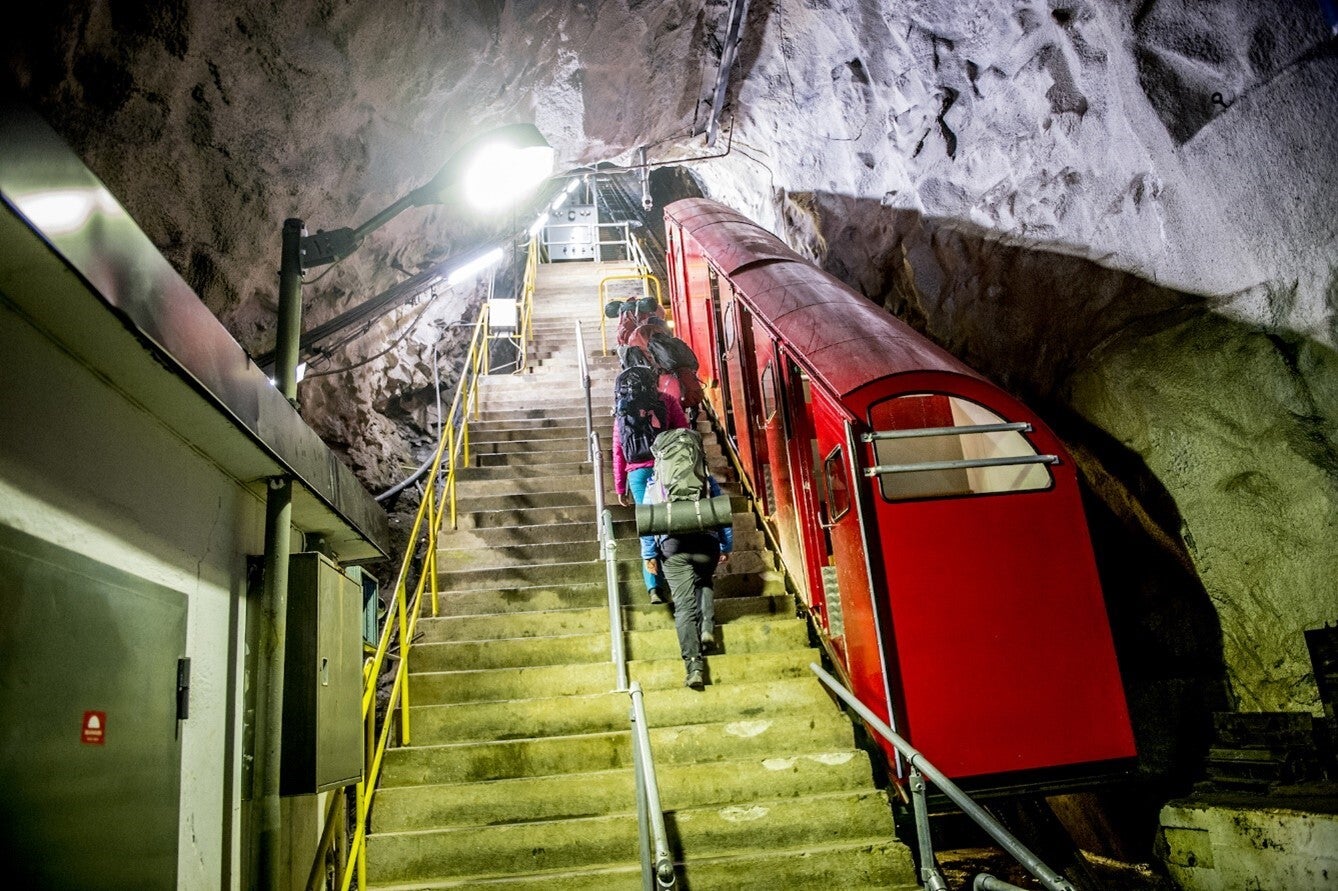
Photo: Helge Songe / https://creativecommons.org/licenses/by-sa/4.0/
Gaustabanen, Gaustatoppen
Gaustabanen is unlike any other mountain lift in Norway. Instead of rising above the landscape, it moves through the mountain itself. Built in the late 1950s during the Cold War for military use, it was originally a hidden facility inside Gaustatoppen and remained closed to the public for decades before eventually being opened as a visitor experience.
The journey begins deep inside the rock. First, a small train carries you horizontally through a tunnel carved into the mountain. Then, at a transfer point, a cable-driven system takes over and pulls you steeply upward inside the mountain’s core. There are no windows, no outward views, only the quiet sense of moving through solid stone. That absence of scenery makes the arrival even more powerful.
When the doors open near the summit, the shift is immediate. Gaustatoppen stands at 1,883 meters, and on clear days it offers one of the widest panoramic views in Norway. It is often said that you can see up to a sixth of the country from the top.
The summit itself is simple and exposed. A small hut and viewing areas sit close to the peak, but most people move quickly outside to take in the surroundings. In summer, hikers spread across the rocky plateau, following marked paths or simply finding quiet spots to sit and look out. The clarity of the air often makes distant features feel closer than they are.
In winter, Gaustatoppen becomes a destination for ski tourers. The terrain is demanding, and conditions can change quickly, but the reward is a descent through open, high-alpine space with uninterrupted views across southern Norway.
The experience is not about gradual exposure to the landscape, but about a sudden shift, from enclosed darkness inside the mountain to one of the widest views in the country.