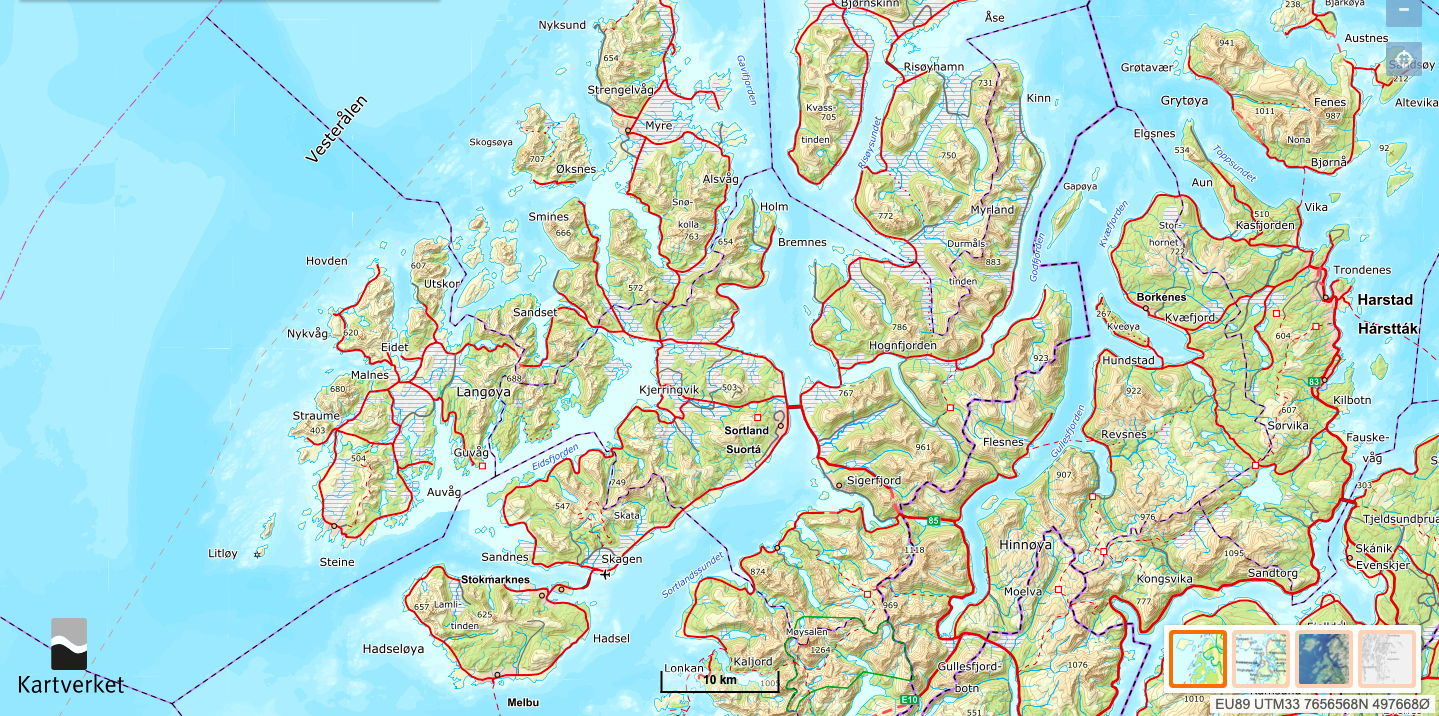
Photo: www.norgeskart.no
About Vesterålen
Vesterålen lies just north of the Arctic Circle, at 68.75° north, often described as Lofoten’s lesser-known neighbor. For many visitors, that’s exactly the appeal. The landscapes are just as dramatic, the wildlife just as rich, but the pace is slower and the crowds thinner. This is a place where fishing villages, open farmland, deep fjords, and sharp mountain peaks exist side by side.
The archipelago consists of five main islands – Andøya, the western part of Hinnøya, Langøya, Hadseløya, and the northern part of Austvågøya – along with more than 1,300 smaller islands, most of them uninhabited. Around 30,500 people live here, spread across five municipalities: Andøy, Øksnes, Bø, Sortland, and Hadsel.

From trading posts to coastal lifeline
Many stories in Vesterålen begin with Richard With, one of the most influential figures in northern Norway. In the late 1800s, he settled in Risøyhamn, where he bought the local trading station and began developing businesses that would transform the region.
Risøyhamn is also closely connected to the Hurtigruten, Norway’s famous coastal express. Founded by Richard With in 1893, Hurtigruten proved that year-round, night-time sailing along the coast was possible. What once took weeks or even months – transporting mail, people, and goods – was reduced to just seven days. This route became a lifeline for coastal communities and remains an iconic way to experience Norway today.
Nearby, the Risøy Channel tells another story of transformation. Opened in 1922, this 4.8-kilometre-long dredged channel turned what was once a shallow sound, passable on horseback at low tide, into a major shipping lane.
Travel in Vesterålen has changed dramatically over the last 50 years. Before the 1970s, ferries were the only way to move between islands, and bad weather could isolate communities for days.
Today, a network of bridges connects the islands, making everyday life easier, safer, and more predictable, and they allowed visitors to explore the region smoothly by road.
Nature and landscape
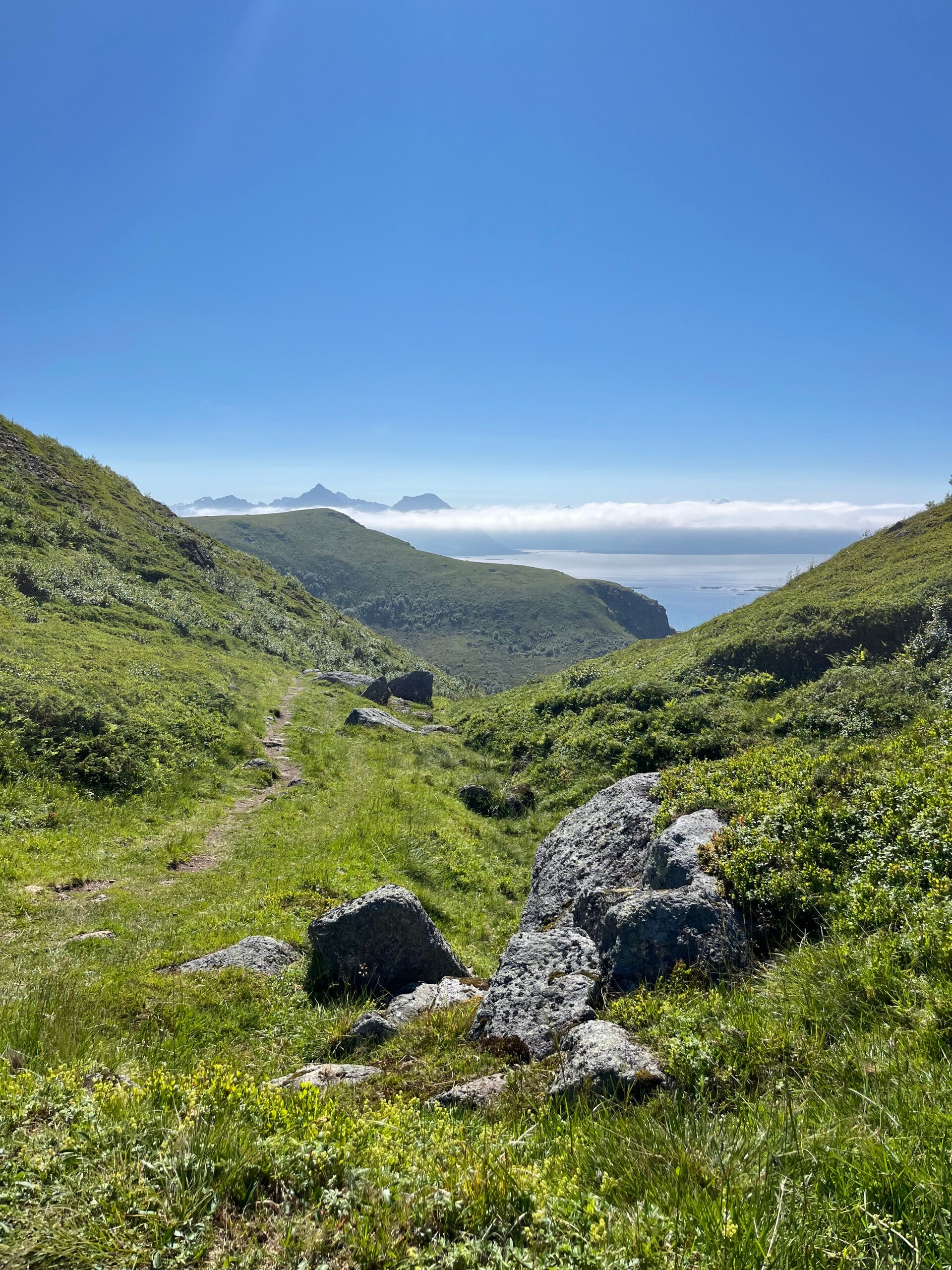
Vesterålen’s landscapes are varied and full of contrast. Sharp, rugged mountains rise straight from the sea, while nearby you’ll find rolling hills, forests, white-sand beaches, wetlands, and sheltered fjords.
One highlight is Forfjorddalen, a protected valley on Hinnøya. Here you’ll find one of Norway’s oldest pine forests. Some of the scots pines are more than 700 years old. Birch and rowan trees dominate most forests today, while spruce plantations from the mid-20th century remain as traces of a forestry experiment that never quite suited the northern climate.
Beneath the ocean surface lies another hidden world. Off the coast are several cold-water coral reefs, including Røstrevet, the largest known cold-water coral reef on Earth. These ecosystems depend on strong currents like the Gulf Stream and support rich marine life.
Wildlife is part of everyday life in Vesterålen. On land, you may see reindeer, moose, and white-tailed sea eagles, with wingspans of up to 2.45 metres.

Life shaped by fishing, farming, and the sea
Vesterålen is one of Europe’s best regions for whale watching. Whale safaris depart mainly from Andenes, and birdwatching, seabird colonies, and seal sightings are common along the coast.
Fishing has always been the backbone of Vesterålen’s economy. Communities such as Bø and Øksnes are deeply rooted in fishing traditions, and the harbor at Myre is Norway’s largest for cod fishing.
Farming has long complemented fishing. Sheep and cattle grazing, hay production, and small-scale agriculture reflect the short but intense growing season. For generations, many families lived as fisher-farmers, combining sea and land to survive.
Today, tourism is growing steadily, with activities such as hiking, kayaking, whale watching, and northern lights safaris. Salmon farming is also a major industry, providing jobs while remaining a topic of environmental debate.
Culture, people, and everyday traditions
Sami heritage
The Sami people have a long history in Vesterålen. In the early 19th century, they made up around 10 percent of the population. Traditionally, Sami communities lived as fishers, hunters, farmers, and reindeer herders.
Although many Sami now live in cities, their culture is experiencing a revival. Language, storytelling, and traditions are being actively preserved, and in Vesterålen, the Inga family continues reindeer herding while sharing Sami culture with visitors.
Towns and communities
- Sortland, known as the “blue town,” is the regional centre of Vesterålen. A millennium art project saw buildings in the town centre painted blue, a once-controversial idea that has become the town’s signature.
- Stokmarknes is the birthplace of Hurtigruten and home to the Hurtigruten Museum and the preserved ship MS Finnmarken.
- Melbu grew from a small trading post into an industrial centre in the late 19th and early 20th centuries, driven by fishing, herring oil production, and local entrepreneurship.

Light, seasons, and atmosphere
Life in Vesterålen is shaped by extreme seasonal light.
- Summer: the midnight sun keeps the sky bright through the night, and locals hike, work, and socialise late into the evening.
- Winter: long periods of darkness are balanced by crisp air, snow-covered landscapes, and frequent northern lights.
This contrast defines everyday life and is one of the strongest impressions for visitors.
Why visit Vesterålen?
Vesterålen is about space, silence, stories, and connection to nature. Whether you come for wildlife, hiking, coastal culture, or simply to slow down, this is a place that reveals itself gradually, and stays with you long after you leave.